Driscoll vs Gibbs: Which Reflective Model to Choose
Compare Driscoll's three‑step and Gibbs' six‑stage models to choose the right reflective approach for quick or in‑depth clinical reflection.

Reflective practice is essential for professional growth in healthcare. Choosing the right model can improve your reflections and meet professional standards like CPD and revalidation. Driscoll's model is simple, using three questions (What? So what? Now what?), making it ideal for quick reflections. Gibbs' model, with six stages, offers a more detailed process, including emotional exploration and analysis, suitable for complex situations.
Here’s the quick breakdown:
- Driscoll: Best for fast, straightforward reflections in busy settings.
- Gibbs: Ideal for in-depth reviews of complex events or professional development.
Quick Comparison
| Feature | Driscoll Model | Gibbs Model |
|---|---|---|
| Number of Stages | 3 | 6 |
| Structure | Linear | Cyclical |
| Focus | Practical actions | Detailed analysis, emotional focus |
| Time Required | Less | More |
| Best For | Routine reflections | Complex scenarios |
Both models have strengths and limitations. Driscoll works well for quick insights, while Gibbs supports deeper understanding. Use the one that fits your needs or combine both for flexibility.
Driscoll vs Gibbs Reflective Models: Side-by-Side Comparison for Healthcare Professionals
What is a Critical Reflection? Introducing the “What, So What, Now What” Model
Start Your Guided Reflection Today
Create structured, CPD-ready reflections using recognized models like Gibbs, Driscoll, Kolb, and ERA. Perfect for NMC revalidation, HCPC CPD, and GMC appraisal.
Start Reflecting NowThe Driscoll Model Explained
John Driscoll introduced this model in 1994, aiming to connect theoretical knowledge with practical application in clinical settings. It’s particularly useful for healthcare professionals who need to record their learning quickly and efficiently.
The model’s straightforward structure is what makes it so practical for reflective documentation.
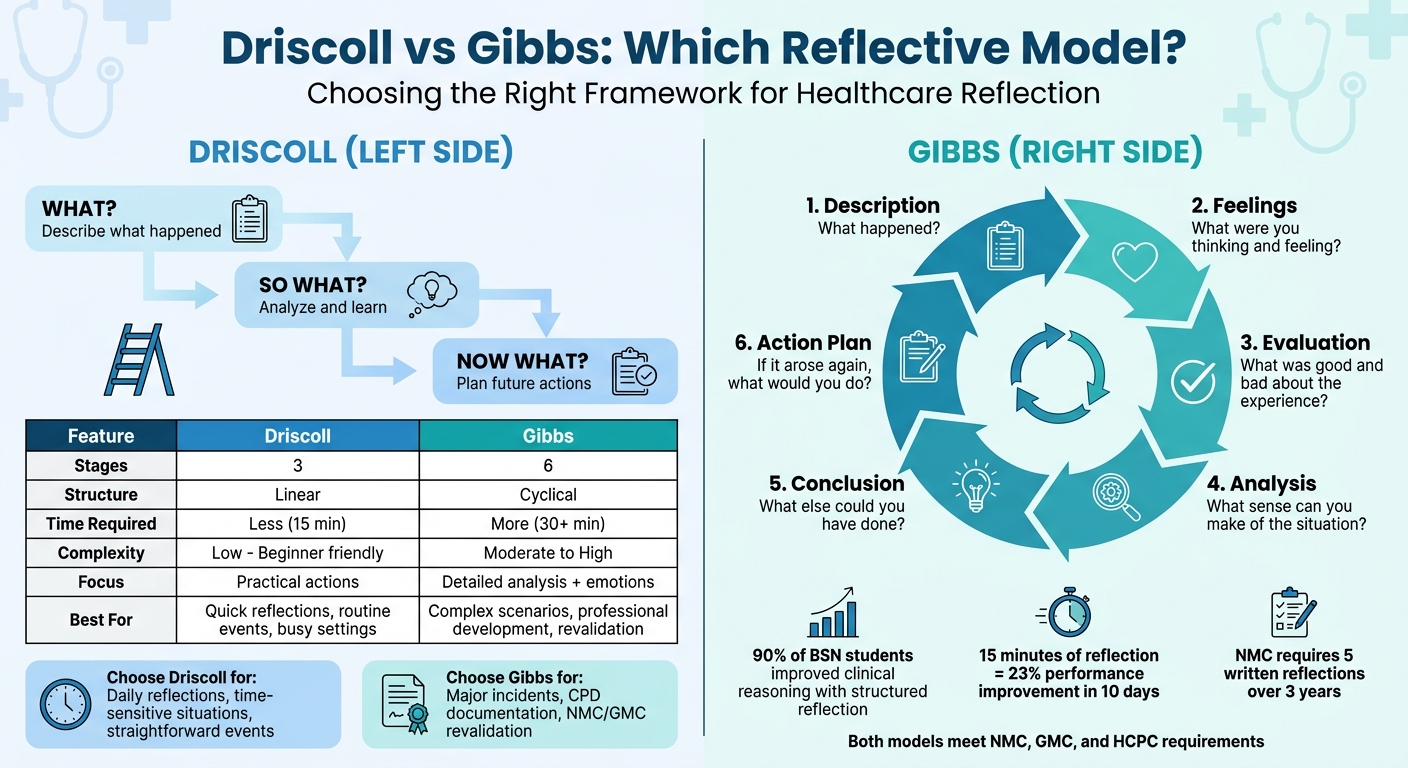
The 3 Stages: What, So What, Now What
The Driscoll Model is built around three stages, each serving a specific purpose:
- Stage 1: What? This stage involves giving a factual account of what happened. It’s all about describing actions and outcomes without adding personal interpretation or analysis.
- Stage 2: So what? Here, the focus shifts to analysing the situation. It involves reflecting on emotional responses, understanding the impact on practice, and identifying key lessons learned.
- Stage 3: Now what? This final stage looks ahead, considering what steps to take next. It’s about planning future actions, identifying training needs, and preparing for similar situations. This stage is particularly useful for documenting Continuing Professional Development (CPD) and professional revalidation. Nursing academic writer Enya Corr highlights the model’s effectiveness:
"The simple and practical approach of Driscoll makes it an effective source for quick reflections on clinical settings or nursing academic issues for students" .
Why the Driscoll Model Is Simple to Use
The model’s clarity and simplicity are its strongest assets. Its three-stage structure is easy to recall and apply, making it ideal for capturing reflections in fast-paced healthcare environments. This straightforward design allows practitioners to document routine clinical experiences without hassle.
As noted by the University of Edinburgh:
"The simplicity of this model is both a great strength and a possible limitation. It is very easy to remember and can be applied to any field or experience" [1].
Thanks to its simplicity, the model works well for professionals at all experience levels. By using targeted prompts like "What was the outcome?" (What?), "How did you react?" (So what?), and "What will you do differently?" (Now what?), it helps ensure reflections go beyond surface-level observations and offer real insight.
The Gibbs Reflective Cycle Explained
Professor Graham Gibbs introduced this model in 1988 , and it has since become a cornerstone in fields like healthcare, education, and professional coaching.
Unlike straightforward linear models, Gibbs' approach is cyclical, ensuring that lessons from one experience shape how you handle the next. This cyclical model, as opposed to a linear one, emphasizes the importance of continuously revisiting experiences, analyzing them from different angles, and using the insights gained to inform future actions and improve decision-making.
The 6 Stages of Gibbs
Gibbs' model is divided into six stages, each designed to guide you through a thorough reflection process.
- Description: This stage focuses on a factual recount of events - what happened, who was involved, and the outcome. It avoids emotional language or analysis, sticking strictly to the facts .
- Feelings: Here, you explore your emotional responses to the situation. Emotions are treated as critical data that can influence future decisions .
- Evaluation: This stage assesses what went well and what didn’t, without delving into the reasons behind these outcomes just yet .
-
Analysis: This is where deeper reflection takes place. You connect your experience to professional guidelines, theoretical concepts, or relevant literature. As People Study Pro highlights:
"The analysis stage is where most reflections fall short. Push beyond 'I should have prepared better' to understand WHY you didn't prepare, WHAT patterns this reveals, and HOW it connects to your professional development" .
- Conclusion: At this point, you summarise the lessons learned and consider alternative actions that could have been taken.
- Action Plan: Finally, you develop a concrete plan for managing similar situations in the future. This might involve pursuing specific training or seeking mentorship opportunities .
How Gibbs Supports Detailed Analysis
Gibbs' six-stage framework allows for an in-depth examination of every aspect of an event, from its emotional impact to its theoretical implications . By dedicating separate stages to emotions and analysis, the model ensures a more rounded and detailed reflection.
What sets this model apart is its ability to blend personal insights with evidence-based reasoning . For professionals undergoing revalidation, such as those registered with the NMC or GMC, the Action Plan stage offers clear proof of ongoing development. It demonstrates that you've identified practical steps to improve your practice . This structured approach not only enhances understanding but also provides a solid foundation for comparing it with the Driscoll model in the following section.
Driscoll vs Gibbs: Key Differences
When comparing Driscoll's and Gibbs' reflective models, the most noticeable difference lies in their structure. Driscoll's approach is divided into three stages – What?, So what?, and Now what? – while Gibbs' model includes six distinct phases. But this isn't just about the number of steps; it highlights two very different ways of approaching reflection.
Driscoll's model is linear and straightforward, making it ideal for professionals who need quick insights without spending too much time . On the other hand, Gibbs' cyclical structure allows for a more detailed exploration of experiences, separating emotions from analysis to ensure a thorough review [2].
Another key difference is how each model handles emotions. Gibbs explicitly includes a stage for exploring feelings, which adds an extra layer of emotional awareness [2]. Driscoll, however, integrates emotional aspects within the broader reflection process without isolating them. As This vs That explains:
"Gibbs' model provides a more structured and detailed approach, while Driscoll's model offers a simpler and more straightforward framework for reflection" .
Comparison Table: Driscoll vs Gibbs
| Attribute | Driscoll's Reflective Model | Gibbs Reflective Model |
|---|---|---|
| Number of Stages | 3 Stages | 6 Stages |
| Structure Type | Linear and straightforward | Cyclical and detailed |
| Stages/Steps | What?, So what?, Now what? | Description, Feelings, Evaluation, Analysis, Conclusion, Action Plan |
| Primary Focus | Practical action and simplicity | In-depth analysis and emotional awareness |
| Time Required | Low; suited for quick reflections | High; requires more time for depth |
| Complexity | Low; beginner-friendly | Moderate to high; more systematic |
| Best Use Case | Quick reflections in busy settings | Complex scenarios or professional development |
This comparison helps determine which model works best for different situations. For healthcare professionals undergoing NMC or GMC revalidation, the choice depends on the context. For instance, Driscoll's model is perfect for quick reflections, like addressing a 30-minute medication delay. Meanwhile, Gibbs' model is better suited to unpacking more complex issues, such as ethical dilemmas in patient care .
Pros and Cons of Each Model
Each reflective model comes with its own set of strengths and challenges. Understanding these can help you decide which one suits your needs best, whether you're navigating fast-paced shifts or working on detailed revalidation.
Here’s a breakdown of the practical advantages and limitations of each model.
Driscoll Model: Pros and Cons
| Pros | Cons |
|---|---|
| Quick and Action-Focused: Encourages a swift move towards actionable solutions with its "Now what?" approach . | Limited Depth: May oversimplify complex, interconnected issues . |
| Time-Efficient: Perfect for capturing reflections in busy healthcare settings . | Linearity: Its strict three-step structure can feel limiting in nuanced scenarios . |
| Easy to Apply: Simple format that doesn't require prior training . | Less Emotional Detail: Lacks prompts for deeper emotional exploration compared to other models like Gibbs . |
Driscoll’s model works well when time is of the essence, but this speed can mean sacrificing a deeper, more nuanced understanding of complex situations.
Gibbs Model: Pros and Cons
| Pros | Cons |
|---|---|
| Comprehensive Framework: Ideal for detailed CPD documentation and professional revalidation . | Time-Consuming: Completing all six stages can take considerable time . |
| Emotional Intelligence: Encourages reflection on feelings, fostering greater self-awareness . | Complex: Might feel overwhelming for beginners in reflective practice . |
| Holistic View: Helps uncover assumptions and identify key learning points . | Repetitive: Some stages, like Evaluation and Analysis, may feel redundant to some practitioners . |
Gibbs’ model provides a thorough and detailed framework, making it especially beneficial for professional growth. As noted by This vs. That:
"Gibbs Reflective Model offers a comprehensive framework for in-depth reflection and critical analysis, making it a valuable tool for professionals seeking to enhance their reflective practice skills" .
Which Model Should Healthcare Professionals Choose?
Choosing the right reflective model depends on the complexity of the situation and how much time you have. Neither Driscoll nor Gibbs is inherently better - they each serve different needs. Your choice should hinge on whether you’re aiming for quick insights or a more detailed analysis.
When to Use Driscoll
Driscoll’s three-stage model is perfect when time is tight, and simplicity is key. It’s particularly suited for routine clinical events that need quick reflection and actionable takeaways. As nursing research writer Enya Corr puts it:
"The simple and practical approach of Driscoll makes it an effective source for quick reflections on clinical settings... best for busy individuals" .
This model works well for daily reflections, straightforward assessments, or for those just starting with structured reflection. If you’re in the middle of a hectic shift and need to jot down key learning points without diving too deep, Driscoll is your go-to choice. However, for more intricate situations, a model offering deeper exploration may be more appropriate.
When to Use Gibbs
For more complex or significant events, Gibbs is the better option. Its six-stage framework allows for a thorough examination of experiences. Enya Corr highlights its value:
"Use Gibbs when you require a detailed, thorough analysis of your experiences. It is ideal for professional development or when you need to generate new perspectives" .
This model is ideal for reflecting on major clinical incidents or meeting professional revalidation requirements. It supports emotional understanding and encourages comprehensive analysis. For example, a study involving 130 BSN students revealed that 90% saw improvements in clinical reasoning through structured reflection . To make the most of Gibbs, don’t overlook the "Feelings" and "Analysis" stages - these are crucial for gaining deeper insights and creating evidence for professional growth.
Practical Tips for Reflective Practice and Revalidation
Making reflective practice both manageable and compliant is key. For revalidation, the Nursing and Midwifery Council (NMC) requires nurses and midwives to complete five written reflections over a three-year period. Each reflection needs to explain what you learned, how it improved your practice, and how it connects to the NMC Code [3]. Using the right tools and a structured approach can make this process far easier.
How Reflection Guide Simplifies the Process
Reflection Guide is designed to take the guesswork out of reflective practice. It offers guided templates for popular models like Driscoll and Gibbs, walking you through every stage. For example, whether you're using Driscoll's three-step framework or Gibbs' six-stage model, the platform ensures you cover all the necessary elements. It even prompts you to link your reflections to the NMC Code's four themes: prioritising people, practising effectively, preserving safety, and promoting professionalism and trust.
One standout feature is its privacy check, which flags any identifiable information - a critical step for professional documentation. Once your reflection is complete, you can generate drafts that are ready for export. These drafts meet the NMC's mandatory template requirements and are suitable for professional portfolios or for sharing with your reflective discussion partner. The platform’s templates also align with standards set by both the NMC and the Health and Care Professions Council (HCPC), ensuring compliance across regulatory frameworks.
Meeting Professional Standards
Adhering to professional standards is non-negotiable. Bodies like the HCPC and General Medical Council (GMC) have similar requirements for continuing professional development (CPD) and appraisals. Regardless of which reflective model you use, your reflection must clearly demonstrate how the experience ties back to your professional code. For instance, if you're reflecting on a medication error using Gibbs' model, your analysis should directly reference the Code standards that were followed - or need improvement.
To stay compliant, store your reflections and signed reflective discussion forms in a dedicated portfolio, whether it’s paper-based or digital. If you work in a setting with few registered professionals, consider using professional networks or video conferencing to find a reflective discussion partner. This ensures you meet the requirements, even in challenging circumstances.
Conclusion: Making the Right Choice
Deciding between Driscoll and Gibbs isn't about picking the "better" model - it’s about choosing the one that aligns with your specific needs. Both frameworks are valuable tools that meet regulatory requirements and support reflective practice.
The decision often comes down to the situation at hand. For example, if you’re reflecting on a straightforward clinical event during a hectic shift, Driscoll’s three-stage approach offers a quick and efficient way to capture practical insights. Research indicates that just 15 minutes of structured reflection can enhance performance by 23% within 10 days .
On the other hand, for more complex or emotionally charged clinical incidents, Gibbs provides the depth needed to explore feelings, challenge assumptions, and create action plans. Studies have shown that structured reflection improves clinical reasoning in 90% of BSN students , highlighting its importance in tackling intricate scenarios.
It’s also worth noting that you don’t have to stick to one model. Many healthcare professionals use Driscoll for routine reflections, ensuring consistency, and turn to Gibbs for more significant events that require detailed analysis, particularly for their revalidation portfolios. This blended approach showcases both regular reflective practice and the ability to engage in deeper critical thinking when necessary.
Ultimately, the best model is the one that complements your practice. As John Dewey famously said, "We do not learn from experience; we learn from reflection on experience" . Whether you prefer Driscoll’s simplicity or Gibbs’ detailed structure, what truly matters is committing to consistent and meaningful reflection.
FAQs
Which model should I use for revalidation evidence?
When deciding on the best reflective model, it really comes down to your personal needs and preferences. Gibbs' Reflective Cycle offers a six-stage process, making it a great choice for thorough analysis and deeper critical thinking. This model is often favoured for revalidation due to its structured, step-by-step approach.
On the other hand, Driscoll's model keeps things simple. It revolves around three straightforward questions: 'What?', 'So what?', and 'Now what?'. This makes it a practical option for those who prefer a more concise framework.
Both models align with UK revalidation standards when used properly. So, whether you want a detailed structure or a more streamlined method, the choice depends on how much detail and guidance you prefer.
How can I reflect on a serious incident without breaching confidentiality?
When thinking back on a serious incident, it's essential to centre your reflection on your personal experience, emotions, and the lessons you gained, rather than delving into specific details that might reveal sensitive or identifiable information about others involved. Aim to describe the situation in broad terms, steering clear of any data that could compromise confidentiality. Instead, focus on how the event contributed to your professional development.
To keep your reflection organised and meaningful, you might find it helpful to use structured frameworks like Gibbs' Reflective Cycle or Driscoll's Model of Reflection. These tools can guide you through the process, ensuring your reflection remains focused on growth and learning while preserving privacy.
Can I combine Driscoll and Gibbs in one reflection?
Yes, it’s possible to use Driscoll's and Gibbs' reflective models together. Driscoll's three-step framework - 'What?', 'So what?', and 'Now what?' - keeps things straightforward and goal-oriented. On the other hand, Gibbs' six-stage model allows for a more detailed examination of an experience. By first applying Gibbs to delve deeply into an event and then using Driscoll to concentrate on the lessons learned and future steps, you get a well-rounded approach. This blend works especially well in fields like healthcare and professional growth.