Top Reflective Models for GMC Appraisal
Compare Gibbs, Driscoll, Kolb and ERA to write concise, compliant GMC appraisal reflections with clear learning and actions.
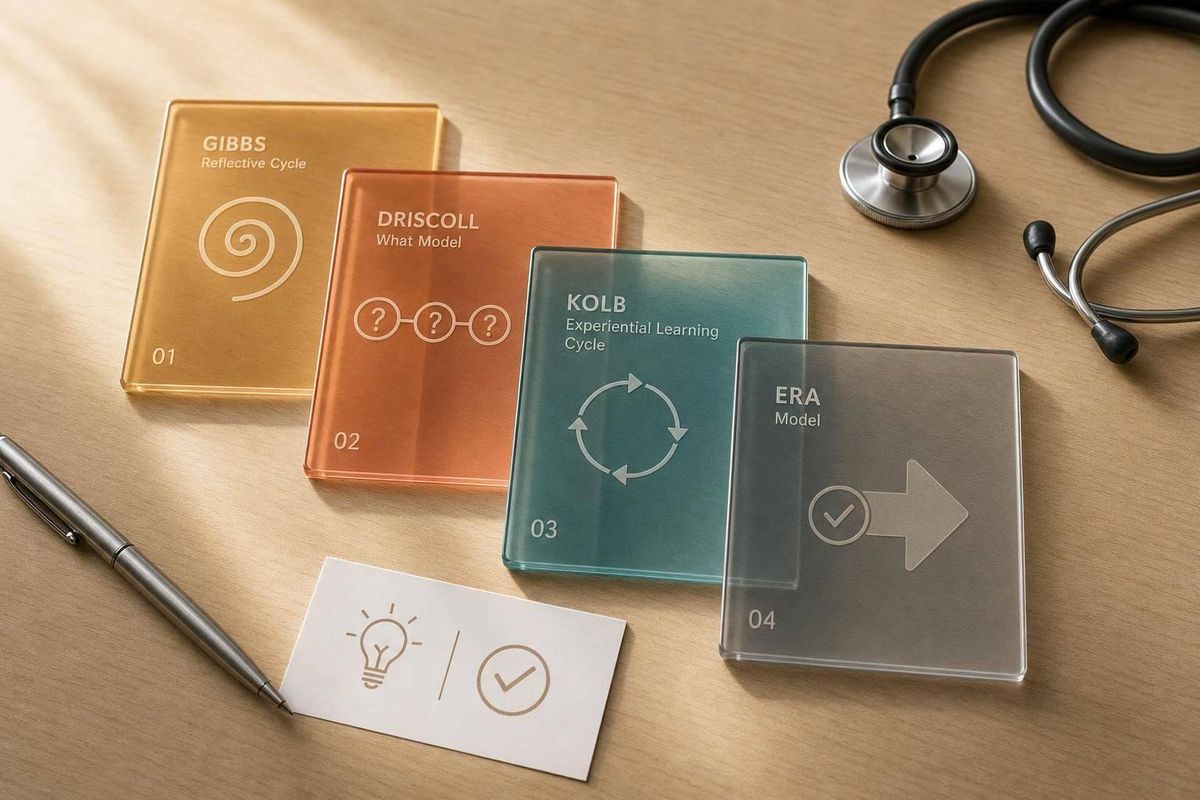
If I want the short answer: start with Driscoll for most routine notes, use Gibbs for harder cases, pick Kolb for training, and use ERA when I need a very short write-up.
For GMC appraisal, reflection is not about retelling a case. It is about showing what I learned, what changed in my practice, and what I will do next. In this article, I compare four models - Gibbs, Driscoll, Kolb, and ERA - and match each one to the type of appraisal entry where it works best.
Here is the article in one glance:
- Gibbs: best for major events, complaints, and hard feedback
- Driscoll: best for routine CPD and simple feedback notes
- Kolb: best for courses, teaching, and skill updates
- ERA: best for short CPD logs and brief meeting notes
- For all four, I need to keep entries fully anonymised
- Appraisers want analysis and action, not a long case story
- A good note should show:
- what I will do differently
- what I will keep doing
- what I will stop doing
A simple point stands out: the shorter the entry, the simpler the model can be. Gibbs has 6 stages, Driscoll has 3, Kolb has 4, and ERA has 3. That alone can save time across a year of appraisal writing.
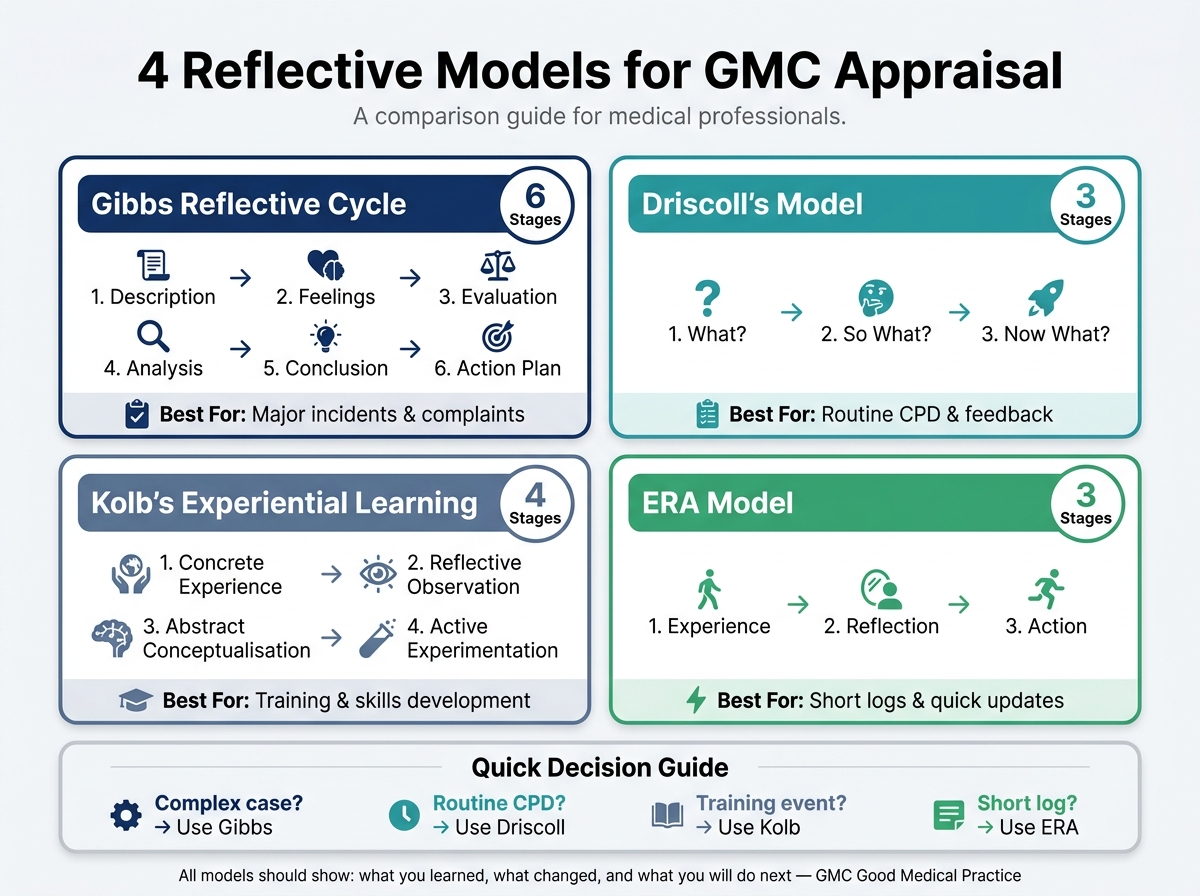
4 Reflective Models for GMC Appraisal: Quick Comparison Guide
Doing 'Reflection' for Medical Appraisal 🧠 | Doctors Appraisal UK | Medical Appraisals
Start Your Guided Reflection Today
Create structured, CPD-ready reflections using recognized models like Gibbs, Driscoll, Kolb, and ERA. Perfect for NMC revalidation, HCPC CPD, and GMC appraisal.
Start Reflecting NowQuick Comparison
| Model | Stages | Best for | Main strength | Main risk |
|---|---|---|---|---|
| Gibbs | 6 | Major incidents, complaints, hard cases | More room for analysis and feelings | Can become too long |
| Driscoll | 3 | Routine CPD, feedback | Short and action-led | Can stay too shallow if rushed |
| Kolb | 4 | Training, teaching, new skills | Links learning to practice | May be too detailed for small entries |
| ERA | 3 | Short logs, quick updates | Very easy to use | May miss depth |
One more point matters: GMC reflection links back to the four domains of Good Medical Practice. So whichever model I use, the note should still show a clear learning point, a practice change, and a next step.
Gibbs and Driscoll: two practical starting points
Use Gibbs when you need to think something through properly. Use Driscoll when you need a short note that still leads to action.
| Feature | Gibbs Reflective Cycle | Driscoll (What? So What? Now What?) |
|---|---|---|
| Structure | 6 stages: Description, Feelings, Evaluation, Analysis, Conclusion, Action Plan | 3 stages: What? / So What? / Now What? |
| Depth | Deep - requires emotional exploration and detailed analysis | Concise - focuses on moving quickly from activity to practice change |
| Best use case | Significant events, complaints, complex clinical cases | Routine CPD, feedback, smaller quality improvement activities |
| Strengths | Explicitly acknowledges the emotional dimension of healthcare | Fast and efficient; reduces the administrative burden of appraisal |
| Limitations | Can become repetitive or overly long if not managed carefully | May lead to superficial reflection if the So What? stage is rushed |
The notes below show how each model works in practice.
Gibbs reflective cycle for significant events and complex feedback
Gibbs is the better fit when an event needs proper unpacking. The six stages take you from description to action, with space to look at context, analysis, and what happens next.
That extra room matters in healthcare. It lets you deal with the emotional side as well as the facts, which is why Gibbs suits significant events, complaints, and difficult cases.
For short CPD notes and routine feedback, Driscoll is usually the faster option.
Driscoll for brief CPD and feedback reflections
Driscoll works well when you need a brief, action-led reflection. It suits courses, e-learning modules, patient feedback summaries, and straightforward colleague reviews.
The main thing is not to rush the So What? stage. Keep it specific. Show how the activity links to your practice, then state the action you will take.
Kolb and ERA: models for learning and concise documentation
When Gibbs and Driscoll fit most appraisal notes, Kolb and ERA tend to work better for learning from a training event, a skills update, or a short piece of experience.
| Feature | Kolb's Experiential Learning Cycle | ERA (Experience, Reflection, Action) |
|---|---|---|
| Best for learning depth | Strong - links theory to practice through conceptualisation | Some - focuses on practical application and immediate change |
| Speed | Moderate - four distinct stages | High - a stripped-back three-step process |
| Best for | Formal training, teaching, and skills development | Routine CPD and quick portfolio updates |
| Limitations | Can be too detailed for minor routine reflections | May lead to superficial reflection if not used carefully |
| Strengths | Links theory to practice; supports deeper learning | Saves time |
Kolb for training, teaching, and skills development
Kolb moves through four stages: Concrete Experience, Reflective Observation, Abstract Conceptualisation, and Active Experimentation. In a GMC appraisal, that helps you show how a learning event changed your practice, not simply that you turned up.
The key stage is often Abstract Conceptualisation. That’s the point where “this happened” becomes “this changes how I practise”. HEIW Revalidation Wales notes that appraisers want to see how a course, reading, or e-module has changed or updated practice or patient care [1].
Kolb can also work well for teaching. If you've ever taught something and then realised your own grasp had a gap, you’ll know why. The model can bring out what you learned, not just what the learner took away.
ERA for short entries with clear actions
ERA - Experience, Reflection, Action - is a good fit for shorter entries. It gives you a simple way to show what happened, what you learned, and what changed after that.
For GMC appraisal, the Action part carries the most weight. Be plain about it: what will you do differently, what will you keep doing, and what will you stop doing?
If you need to record the same learning in fewer words, ERA gives you a faster structure. The best model depends on the kind of entry you’re writing.
Reflection Guide can help you draft concise ERA reflections with privacy checks to support confidentiality.
How to match the reflective model to each appraisal entry
The GMC doesn't require one set model, but it does expect reflection across all four domains of Good Medical Practice . So the choice is yours. And if you match the model to the type of entry, you'll usually save time and end up with clearer notes.
With that in mind, here's a simple way to line up the four models covered in this article:
| Model | Best-Fit Scenario | Typical Appraisal Use |
|---|---|---|
| Gibbs | Complex incidents, complaints, significant events | Significant Event Analysis, near-misses |
| Driscoll | Brief CPD, feedback from patients or colleagues | Routine CPD entries, feedback summaries |
| Kolb | Training, teaching, new clinical skills | Educational courses, workshops, new procedures |
| ERA | Quick routine entries, short summaries | Short CPD entries, meeting reflections |
Match the model to CPD, events, feedback, and quality improvement
A good rule of thumb is to match the model to the weight of the entry. Gibbs works well for significant events and complaints, where you need more space to think through what happened and what you'll do next. Driscoll or ERA fit brief CPD notes and feedback entries better, especially when the point is simple and the learning is clear. Kolb tends to suit training, teaching, and skills updates, particularly when learning from a course or project changes your practice.
You can think of it like this:
- Use Gibbs for major incidents
- Use ERA for small routine QI logs
- Use Kolb when learning from a project leads to a change in practice
Keep the description short. The part that matters most is your analysis and next action. That's where the entry earns its keep.
Use one consistent structure across the year
It often helps to use one default model for routine entries, then switch to a fuller model only when the case calls for it. That makes it easier for your appraiser to follow your thinking. It also speeds things up, because you're not rebuilding your structure every time you sit down to write.
In practice, that usually means using one default format for day-to-day entries, then keeping Gibbs for the notes that need deeper analysis.
Reflection Guide supports all four models covered here, with guided reflection tools and built-in privacy checks - handy if you want one steady structure without having to rebuild it each time you write.
Conclusion: choosing a model that supports clear, compliant reflection
Each model suits a different kind of GMC appraisal note. Gibbs works well for more involved cases, Driscoll fits routine CPD, Kolb is useful when the focus is learning, and ERA is handy for short entries.
Whichever one you pick, the standard stays the same. The GMC wants reflections that show what you learned and what you’ll do next, not a long case narrative. That’s also what appraisers are looking for[1].
So the writing rule is pretty simple: use a default model for day-to-day entries, and make sure each note ends with a clear next step. That helps keep your portfolio clear, concise, and ready for appraisal.
Reflection Guide helps you draft structured reflections across Gibbs, Driscoll, Kolb, and ERA, with privacy checks to help keep entries confidential.
FAQs
Which model should I use most often?
There’s no one model you need to use every time. Pick the one that fits the situation and what you need from the reflection.
Use Driscoll for quick, clear reflections or routine clinical experiences. Use Gibbs for cases that are more complex or emotionally charged and need a deeper, more structured review. In the end, the quality of your reflection matters more than the model you choose.
How much detail should a reflection include?
For a GMC appraisal, your reflection doesn’t need to cover every detail of what happened. Give enough context to make the event clear, then spend most of your time on what you learned and what you’ll do next.
Go for depth rather than a long description. Skip vague comments and spell out how the experience changed or updated your practice. That means pointing to clear actions, not just saying you’ll “be more aware” or “do better”.
How do I keep GMC reflections confidential?
Anonymise all patient details so no one can be identified. Taking out names on its own isn't enough, and full case details can still point to a person.
Keep the focus on what you learned, the insight you gained, and what you'll do differently in future practice. Put factual clinical detail somewhere else. Reflective notes are for professional development, not a full clinical report.
A structured tool such as Reflection Guide can help you stay on track with these confidentiality practices.