How Clinical Outcomes Support Revalidation
Outcome data plus structured reflection and completed audits turn clinical measures into convincing revalidation evidence.

If I want stronger revalidation evidence, clinical outcomes are one of the best places to start. They show not just what I did, but what happened after: safer prescribing, better control of long-term conditions, fewer incidents, or improved patient-reported scores.
Here’s the short version:
- Outcome data matters because regulators want proof of safe, effective practice, not just a list of tasks.
- The best measures are linked to my own role and cover my full scope of work.
- Numbers alone are not enough. I need to explain what the data showed, what I learned, and what I changed.
- Audit and QI work well because they show a clear before-and-after story.
- Reflection turns data into appraisal evidence. A simple structure like What? So what? Now what? keeps it focused.
- Context matters when data is messy, team-based, or based on small numbers.
- A short set of well-explained measures is better than a long list of weak ones.
In practice, I’d use things like QOF results, prescribing safety reports, incident trends, case reviews, therapy goal scores, PROMs, and patient feedback. Then I’d link each one to a date range, patient group, my part in the work, any limits in the data, and the action I took.
One point stands out: a completed audit cycle usually carries more weight than a one-off snapshot because it shows problem, action, and result in one line.
So the aim is simple: pick one measure, explain it clearly, reflect on it honestly, and show the change. That is what makes outcome data useful for revalidation.
NMC revalidation - a simple overview with key tips to help you prepare

How clinical outcomes support evidence of professional competence
Raw numbers don't become revalidation evidence on their own. You need to analyse them, reflect on them, and show what changed in your practice. Appraisers want to see your judgement, not just a set of results. Clinical outcomes support competence when they show safe practice, not just activity. The next step is to link those results with other evidence so their meaning is clear.
"A list of audit results printed from EMIS is data. A reflective account explaining what those results revealed, what you changed in response, and how patient outcomes improved as a result - that is evidence suitable for your appraisal portfolio." - Axiom Appraisals
Matching outcome measures to your scope of practice
Each measure needs a clear reason behind it. Explain why it fits your scope of practice, how the data was collected, and the time period it covers. Pick outcomes you can justify in appraisal, not just figures that happen to be easy to pull.
A GP might use QOF metrics, prescribing reviews, referral audits, and minor surgery outcomes. A hospital doctor might draw on Datix incident data, prescribing safety reports, or trust-level quality dashboard figures. For nurses and midwives, patient and service-user feedback, clinical incidents, and near misses are all valid starting points.
If your work covers NHS and private practice, or also includes teaching or leadership, your outcome evidence should cover your full scope of practice, not just your main post.
Pairing numbers with feedback, incidents and case review
Quantitative outcomes help, but they only tell part of the story. A shift in a metric shows that something happened. It doesn't explain why, or whether your actions caused the change. Patient and service-user feedback, colleague 360-degree reviews, and significant event analyses add the context that numbers miss.
When you put these sources together, you get a more rounded picture of competence. For example, a significant event analysis might show a communication gap that a prescribing safety report had already flagged in the numbers. Side by side, they show more than the fact that something went wrong. They show that you understood the issue and acted on it. That clear line from problem to action to result is often what makes evidence persuasive in appraisal. It's also what makes the material ready for reflection.
Using audit and quality improvement as revalidation evidence
A completed clinical audit cycle is one of the clearest ways to show impact on patient care. The baseline, intervention, and re-measurement cycle sets out the problem, your response, and the result. That shows decision-making, follow-through, and measured impact.
Quality improvement methods such as PDSA work in much the same way. If the cycle isn't complete yet, say so plainly and record the re-audit date. Those results can then feed into the reflective account in the next section.
Turning outcome data into reflective revalidation evidence
Once you have outcome data, the next step is turning it into a reflective account. Data only becomes revalidation evidence when you analyse it, reflect on it, and show what changed.
"Evidence, in the appraisal context, is what you do with that data. Evidence involves analysis, reflection, identification of learning, and demonstration of change."
Writing reflective accounts from outcome trends and events
A reflective account needs a clear thread from data to action. Start with what the data showed, such as an audit result, patient feedback, or a quality improvement activity. Then explain what it meant, what may have shaped the outcome, your clinical reasoning at the time, and which professional standards applied. End with what you changed as a result.
The what, so what, now what structure works well because it keeps the writing tied to learning and action. It stops the account from drifting into a plain summary of events. Appraisers value honesty more than a polished story . If there were gaps, say so plainly and note the next step.
Using recognised reflection models to analyse outcome data
Structured reflection models give you a clear way to move from description to analysis without losing the point. They help you avoid a common problem: listing what happened without showing what you learned from it.
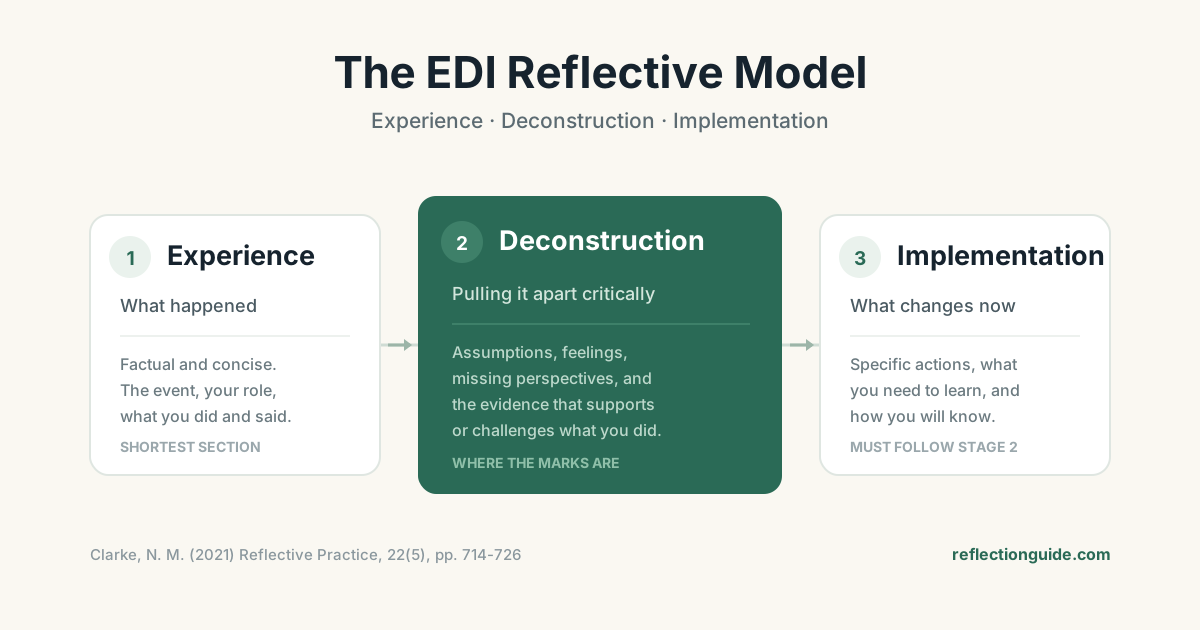
The table below shows a few recognised models that work well for outcome-based reflection.
| Model | Structure | Best suited for |
|---|---|---|
| Gibbs | Description → Feelings → Evaluation → Analysis → Conclusion → Action Plan | Detailed analysis of a specific incident or audit trend |
| Driscoll | What? → So What? → Now What? | Quick, structured reflection on outcome data or patient feedback |
| Borton | What, So What, Now What | Simple framework for moving from description to action [1] |
| Johns | Looking in / Looking out | Deeper reflection on complex clinical experiences [1] |
For NMC revalidation, the key requirement is at least five written reflections on CPD, feedback, or practice-related events over three years [1]. For GMC appraisal, it helps to map your analysis to the four domains of Good Medical Practice, especially Safety and Quality . HCPC registrants should link reflections clearly to how the activity improved the quality of their work and benefited service users .
Using Reflection Guide for structured, confidential drafting
Reflection Guide helps structure drafts, link them to standards, and flag identifying details before export. That matters when you are working with patient outcome data or incident details. The finished drafts are export-ready for NMC revalidation, HCPC CPD records, and GMC appraisal portfolios. These drafts can then feed straight into portfolio entries.
Start Your Guided Reflection Today
Create structured, CPD-ready reflections using recognized models like Gibbs, Driscoll, Kolb, and ERA. Perfect for NMC revalidation, HCPC CPD, and GMC appraisal.
Start Reflecting NowBuilding a revalidation portfolio with outcome evidence
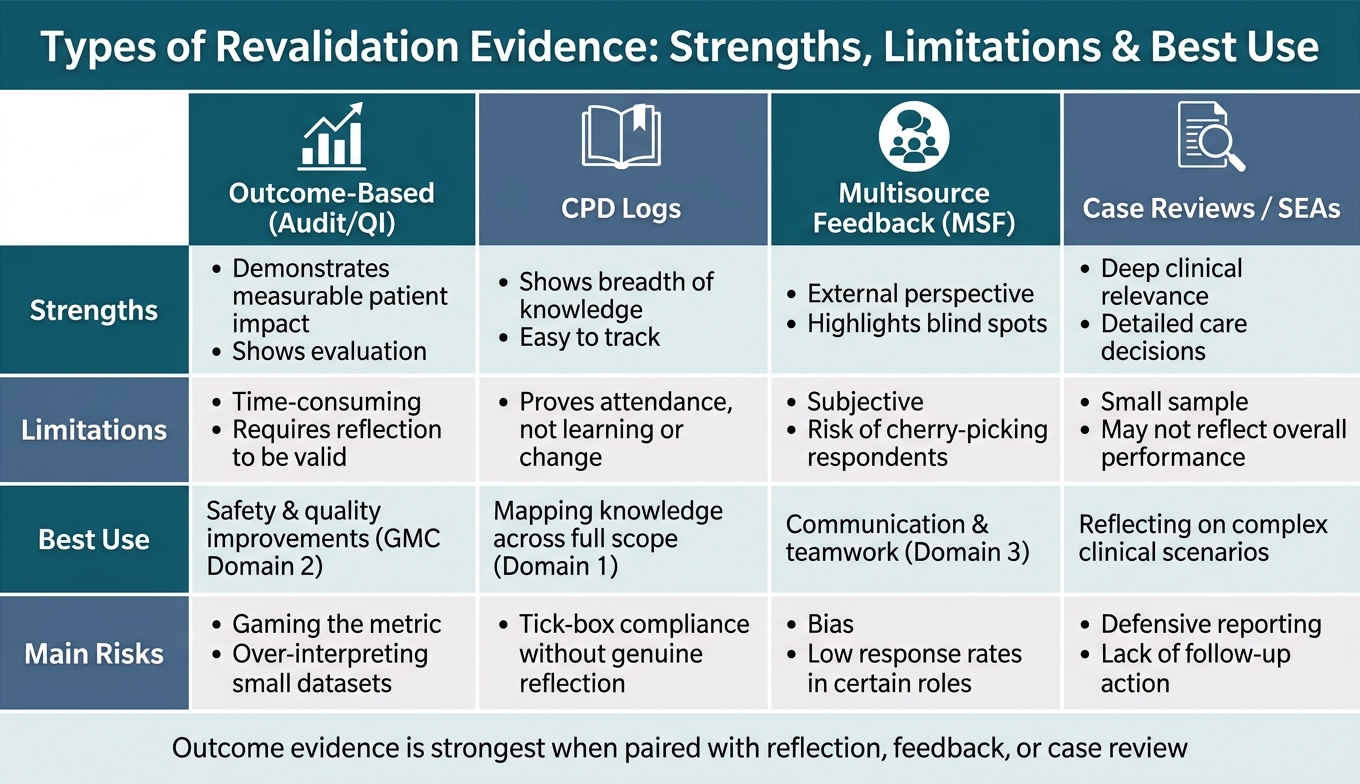
Types of Revalidation Evidence: Strengths, Limitations & Best Use
Once you’ve reflected on the data, the next job is to turn it into portfolio evidence that an appraiser can scan and grasp fast. Reflected-on data only becomes portfolio evidence when it is set out clearly and you can justify it.
Choosing outcome measures that are relevant and defensible
The best entries use measures you can explain in plain terms. Pick measures you can link to your own actions, talk through at appraisal, and defend with context - not a number that sits on the page but has little connection to your own work .
A small set of strong measures is better than a long list of weak ones .
| Role/Setting | Relevant Outcome Measures | Data Sources |
|---|---|---|
| General Practice | Minor surgery outcomes, referral audits, prescribing safety (e.g. DMARDs monitoring), QOF achievement | EMIS Web, SystmOne, Medicines Optimisation dashboards |
| Acute/Secondary Care | National clinical audits (e.g. SSNAP), surgical complication rates, mortality reviews, incident reporting trends | Cerner, Epic, Datix, Trust quality dashboards |
| Public health and allied health | Service evaluation, patient record reviews, peer review of clinical practice | Service registries, case note audits |
A simple check helps with every entry: can you show what the measure was, why it mattered, and what changed?
Presenting each outcome clearly in portfolio entries
Each portfolio entry should use the same basic structure, so the appraiser can follow your reasoning without digging around for missing pieces. A useful format includes the clinical indicator, the data source, the date range, the patient group, the main result, your interpretation, any limits, and the action you took as a result .
For example, you might include a date range such as 1 January 2024 to 31 December 2024. That kind of detail matters. It shows the data is tied to a clear period, not pulled from a vague snapshot.
Use the narrative summary to show change, learning, and next steps. Where you can, include a completed audit loop.
"A completed audit cycle is substantially stronger evidence than a single snapshot."
Strengths and limitations of outcome-based evidence
Outcome evidence is often seen as more justifiable than CPD logs because it shows the impact of your practice, not just that you kept your knowledge up to date . That said, it does have limits, and saying so plainly is part of presenting it well.
"A certificate only proves attendance, reflection proves attention, change demonstrates development and audit shows evaluation." [2]
Small-sample variation, small sample sizes, and case-mix differences can all shape how results appear. If your dataset is small, say so clearly and explain what the data can and cannot show. If an audit cycle is not finished by the time of appraisal, record the reason for the timeline and state that you will re-audit in the following year [2].
Outcome data is strongest when it sits alongside reflection, feedback, or case review. Numbers on their own can tell part of the story. The surrounding context is what makes the entry useful.
| Evidence Type | Strengths | Limitations | Best Use | Main Risks |
|---|---|---|---|---|
| Outcome-based (Audit/QI) | Demonstrates measurable impact on patient care; shows evaluation [2] | Time-consuming to extract; requires reflection to be valid | Demonstrating safety and quality improvements (GMC Domain 2) | Gaming the metric; over-interpreting small datasets; incomplete cycles |
| CPD Logs | Shows breadth of knowledge; straightforward to track | Certificates prove attendance, not learning or change [2] | Mapping knowledge across full scope of work (Domain 1) | Tick-box compliance without genuine reflection [2] |
| Multisource Feedback (MSF) | External perspective on professional behaviour; highlights blind spots | Subjective; potential for cherry-picking respondents [3] | Assessing communication and teamwork (Domain 3) | Bias; low response rates in certain roles [3] |
| Case Reviews/SEAs | Deep clinical relevance; detailed look at specific care decisions | Small sample; may not reflect overall performance | Reflecting on complex clinical scenarios [3] | Defensive reporting; lack of follow-up action [2] |
Use outcome evidence alongside feedback or case review when that helps explain the change you made.
Conclusion: Making revalidation evidence stronger with clinical outcomes
Clinical outcomes only count as revalidation evidence when you add reflection and context. The point is to connect the measure to what you changed.
Outcome measures carry more weight when they show patient benefit, not just activity. Use outcome data alongside feedback or a case review when that helps explain the result. A completed audit cycle is stronger than a single snapshot .
Start with one outcome measure that fits your work, then build a short reflective account around it . Use a recognised framework such as Gibbs' Reflective Cycle or Driscoll's 'What? So what? Now what?' to move beyond description and into analysis and action . For a neat close to your portfolio, you can turn that reflection into a short, confidential draft.
Reflection Guide supports structured reflection using Gibbs, Driscoll, Kolb and ERA, with privacy checks to help protect confidentiality, producing structured drafts suitable for GMC appraisal, NMC revalidation and HCPC CPD.
FAQs
How do I choose the best outcome measure?
Choose a clinical outcome measure that matters in day-to-day practice and fits with evidence-based guidance from NICE or your relevant Royal College.
It needs to be specific, measurable, and relevant to your role and your professional development goals. That way, you’re not just collecting data for the sake of it - you’re looking at something that can help improve the care you give.
For audits or quality improvement work, focus on areas linked to:
- significant events
- known clinical variation
- patient feedback
This gives your data a clear purpose and makes it far more useful when you want to improve care in a meaningful way.
What if my data is small or team-based?
You can still produce useful evidence for your appraisal without piling up lots of data. What matters most is the quality of your reflection, not the sheer amount of information. Even small pieces of evidence from clinical encounters or team meetings can make a strong addition to your portfolio.
What counts is showing how you used the data. Spell out what you noticed, what you learned from it, what you changed, and how that change helped patient care. That’s the part that shows growth.
A PDSA cycle can help here. It gives you a simple way to test and record improvements on a small, fast scale, which is often more practical in day-to-day clinical work.
How often should I re-audit for revalidation?
You should re-audit as part of a complete audit cycle. For nursing professionals, revalidation takes place every three years. For doctors, it takes place every five years.
A clinical audit is not complete without a re-audit. In simple terms, the loop stays open until you check again. Give changes enough time to bed in before you collect data a second time, so you can see whether practice has improved and whether the audit loop has been closed.