
The EDI Reflective Model: Experience, Deconstruction, Implementation
If you've been told to use the EDI model for a reflective assignment, you've probably already discovered there is very little written about it. Search for it and you'll mostly find results about Equality, Diversity and Inclusion, which is a different thing entirely.
This guide covers what the model is, what each stage actually asks of you, and, most importantly, where students lose marks with it.
What EDI stands for
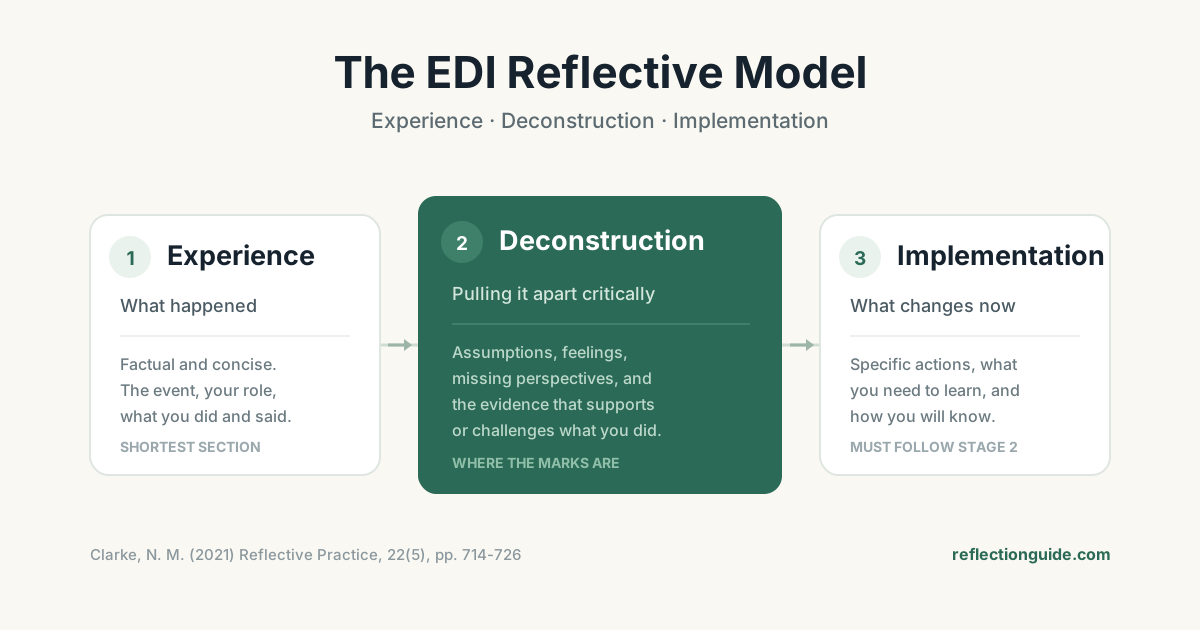
EDI is a three-stage framework for reflective writing:
- Experience: what happened
- Deconstruction: pulling it apart critically
- Implementation: what you'll do differently
It was developed by Nicola M. Clarke at Birmingham City University and published in the journal Reflective Practice in 2021. It's taught at BCU, at Birmingham Newman University, and at a growing number of other institutions.
Why it exists
This is the part worth understanding, because it explains what your marker is looking for.
Most reflective frameworks you'll encounter were not designed for writing essays. Gibbs' reflective cycle came out of experiential learning theory. Driscoll's What? So what? Now what? came out of clinical supervision. It was built to structure a conversation between a practitioner and their supervisor.
Students are then asked to use these models to produce assessed academic writing, which is a different task with different expectations. Clarke's argument is that this mismatch is a large part of why students find reflective assignments so difficult, and why reflective work is often marked lower than other assessment types.
EDI was designed specifically for reflective writing for academic purpose. The stages are deliberately shaped to produce the kind of critical, analytical writing that an academic marker is looking for.
That distinction matters practically. If you write an EDI reflection the way you'd talk through an incident with your practice supervisor, you will write a competent supervision reflection and get a disappointing mark.
Stage one: Experience
Describe the specific event or situation from your practice.
The key words are specific and concise. This is the shortest section of your reflection, and the most common mistake is spending too long here.
Cover:
- What happened, in sequence
- Where you were, and who was involved
- What your role was
- What you actually did and said
Keep it factual. Save your feelings, your interpretation and your analysis for the next stage. That is what it is for.
Two things to get right:
Anonymise properly. No patient names, no colleague names, no ward or bay names, nothing that could identify anyone. Change or omit specific dates. Be careful with rare conditions or unusual circumstances, which can identify someone even without a name.
Pick something small. A brief, ordinary interaction you found difficult will give you far more to analyse than a dramatic emergency. Students consistently choose events that are too big and end up describing rather than deconstructing.
Stage two: Deconstruction
This is the heart of the model, it's where the marks are, and it's where most students come unstuck.
Deconstruction means breaking the experience apart critically: examining your thoughts, your feelings, the assumptions you were making, and the knowledge or theory that bears on what happened.
The failure mode is describing the event again in different words with some feelings attached. "I felt nervous because I hadn't done this before, and I think it went reasonably well." That's a description of a feeling, not an analysis of one.
Questions that push you into actual deconstruction:
- What were you thinking and feeling at the time, and has that changed since?
- What assumptions were you making about the people involved? Where did those assumptions come from?
- What knowledge, evidence, guidelines or theory is relevant here? Does it support what you did, or challenge it?
- Whose perspective is missing from your account? What would the patient say happened? The colleague?
- What would someone more experienced have noticed that you didn't?
- What does this reveal about the limits of your current knowledge or skill?
Two markers of a strong Deconstruction section:
It engages with sources. This is academic writing, so your analysis should connect to literature, professional standards or guidelines. Not decoratively. The evidence should do actual work, either supporting your reasoning or complicating it.
It's willing to be uncomfortable. Reflections that conclude everything went well tend to score poorly, because there's nothing to analyse. The most useful thing you can identify is an assumption you were making that turned out to be wrong.
Stage three: Implementation
How you'll apply what you've learnt to change or improve your future practice.
Vagueness kills this section. "I will communicate better in future" commits you to nothing and demonstrates nothing.
Work through:
- What will you do differently, specifically, and in what situation?
- What do you need to learn or practise, and how will you actually get it?
- How will you know it's worked?
- What will you do the next time this particular situation arises?
Good implementation follows directly from your deconstruction. If your analysis identified a gap in your knowledge of a guideline, the implementation addresses that gap concretely. If the two sections don't connect, the reflection reads as though the ending was bolted on.
EDI compared with Gibbs and Driscoll
| Stages | Originally designed for | |
|---|---|---|
| EDI | Experience, Deconstruction, Implementation | Academic reflective writing |
| Driscoll | What? So what? Now what? | Clinical supervision |
| Gibbs | Description, Feelings, Evaluation, Analysis, Conclusion, Action plan | Experiential learning |
Structurally, EDI and Driscoll are close: three stages, same broad sequence of describe, analyse, plan. If you know Driscoll, EDI will feel familiar.
The difference is what each was built to produce. Driscoll structures a reflective conversation. EDI structures a piece of assessed academic writing, and its middle stage is explicitly designed to push you toward critical analysis rather than letting you settle into description.
Gibbs separates out feelings and evaluation into their own stages, which some students find helpful as scaffolding. The trade-off is that six stages can encourage a box-ticking approach, where each section gets a paragraph regardless of whether it deserves one.
If your course specifies a model, use that one. If you have a choice and you're writing an assessed assignment, EDI is the one built for the job.
Common mistakes
Front-loading the description. Half the word count on Experience leaves nowhere to demonstrate analysis. Aim for something like 20% Experience, 55% Deconstruction, 25% Implementation.
Confusing feelings with analysis. Naming an emotion is the start of deconstruction, not the whole of it. Why did you feel that? What assumption was underneath it? Was the feeling proportionate?
Writing without sources. It's an academic assignment. Your reflection should engage with literature and professional standards.
Choosing an event that was too dramatic. Big incidents invite storytelling. Small, ordinary, slightly uncomfortable moments produce better analysis.
Concluding that you did everything right. If there's nothing to deconstruct, there's nothing to mark.
Reference
Clarke, N. M. (2021) 'Experience, Deconstruction, Implementation: EDI; A New Approach to Reflective Writing for Academic Purpose', Reflective Practice, 22(5), pp. 714-726. doi: 10.1080/14623943.2021.1946775
ReflectionGuide supports the EDI model alongside Gibbs, Driscoll, Kolb and ERA. It structures your own reflections. You supply the experience and the thinking, and it helps you organise them into the shape your assignment needs.