Kolb's Learning Cycle Explained for Healthcare Practice
Turn one clinical event into CPD evidence with Kolb's 4-stage cycle: describe, reflect, link to guidance and test one specific change.

If I want to turn a single shift into CPD evidence, Kolb’s cycle gives me a simple 4-step way to do it.
In plain terms, I start with one clinical event, think back on what happened, link it to guidance or standards, then decide one action to try next time. That matters in UK healthcare because reflection is tied to NMC revalidation, HCPC CPD, and GMC appraisal.
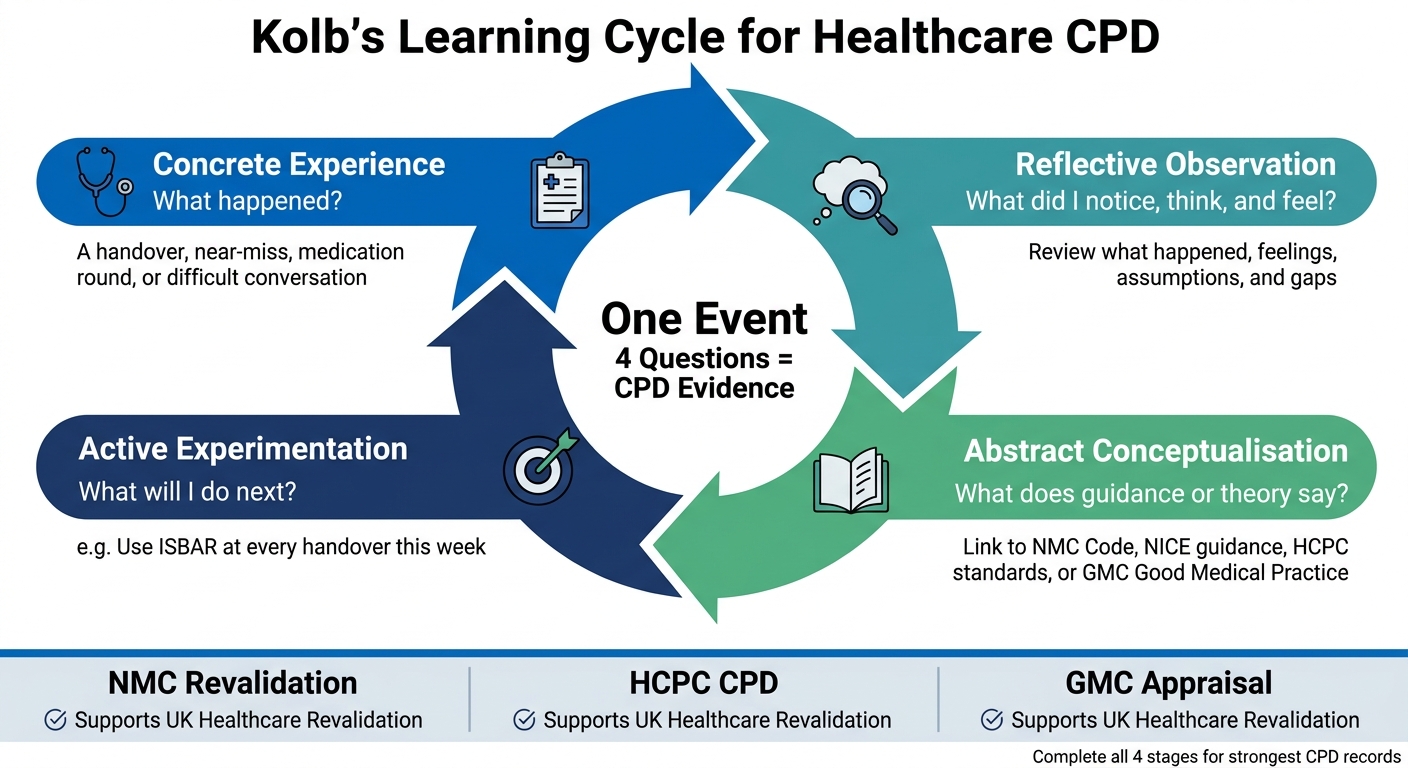
Here’s the full idea in one glance:
- Concrete Experience: what happened
- Reflective Observation: what I noticed, thought, and felt
- Abstract Conceptualisation: what guidance, policy, or theory helps explain it
- Active Experimentation: what I will do next
A few points stand out straight away:
- One event is enough: a handover, a near-miss, a family discussion, or a simulation
- Reflection supports safer care: reviewing mistakes and gaps can help cut repeat errors
- Specific actions work best: “I will use ISBAR at the next handover” is stronger than “I will communicate better”
- Short notes are often easier to keep up than long write-ups after a hard shift
- The cycle works best when I finish all 4 stages, not when I stop at feelings alone
There is also a limit to keep in mind: in busy services, time pressure can make reflection rushed, and without peer input, my view of events can be biased.
A useful fact here is that Kolb’s model has 4 stages, and in practice that means each reflection only needs to answer 4 clear questions. That alone can make writing CPD records far less hard.
The rest of the article explains how I can use those 4 stages in patient care, teamwork, medication safety, simulation, supervision, and formal reflective records in UK practice.
Kolb's Learning Cycle for Healthcare CPD: 4-Stage Framework
Kolb’s Experiential Learning Theory | Medical Education Explained
Start Your Guided Reflection Today
Create structured, CPD-ready reflections using recognized models like Gibbs, Driscoll, Kolb, and ERA. Perfect for NMC revalidation, HCPC CPD, and GMC appraisal.
Start Reflecting NowKolb's Learning Cycle: a step-by-step breakdown
Here’s how the cycle works in day-to-day practice. Kolb’s cycle turns a clinical event into learning: do, review, link it to evidence, then test a change. It’s a loop, not a one-off task.
Concrete experience: starting with a real clinical event
This is the doing stage: the clinical event you are learning from. It could be a ward round, community visit, handover, difficult conversation, simulation or near-miss. The event doesn’t have to be serious or unusual. A routine medication round that felt slightly off, or a team briefing where communication broke down, both count.
Start by describing what happened, who was involved and what you observed - not your interpretation just yet. Keep all patient details anonymous in line with UK confidentiality standards. Use role descriptions such as “a patient” or “a colleague from physiotherapy” instead of names or other identifying details.
Reflective observation and abstract conceptualisation: making sense of what happened
Reflective observation asks what happened, what you were trying to achieve and what you noticed but didn’t act on. This stage brings out feelings, assumptions and gaps that are easy to miss in the moment.
Abstract conceptualisation is where you connect those observations to guidance, standards or theory. Say you noticed a communication barrier during an assessment. At this point, you’d link that to patient-centred communication frameworks or relevant NICE guidance, instead of leaving the reflection as a simple story about what happened.
Active experimentation: changing future practice
Active experimentation turns reflection into a clear change for the next shift. Skip vague aims. Set a specific plan you can test, such as using the ISBAR structure for every handover or applying the teach-back method to check patient understanding.
In practice, the four stages fit neatly into everyday healthcare learning:
| Kolb Stage | Healthcare Action | Example |
|---|---|---|
| Concrete Experience | Direct clinical event | Handling a near-miss during a medication round |
| Reflective Observation | Review what happened | Discussing a difficult handover with a mentor |
| Abstract Conceptualisation | Link to guidance or theory | Connecting a communication gap to patient-centred care frameworks |
| Active Experimentation | Test a specific change | Using ISBAR for every handover on the next shift |
How Kolb's cycle applies to common healthcare learning situations
The same four stages fit neatly into everyday clinical work.
Patient care, communication and multidisciplinary teamwork
Take a nurse delivering difficult news to a patient's family, or a physiotherapist speaking during a ward handover. The four stages give you a simple way to look back at what happened, connect it to communication theory or guidance, and try a clearer approach next time.
Multidisciplinary teamwork gives you the same kind of opening. If a physiotherapist's input gets missed at handover, Kolb's cycle can turn that into a clear next step, such as preparing an ISBAR summary for the next discussion.
This way of thinking also works well for technical skills and safety incidents.
Clinical skills, medication safety and learning from incidents
Near-misses and medication errors can become strong learning moments. If a pharmacist spots a prescribing error, that creates a clear experience to examine. Reflective observation may show how the check was done and why the error was easy to miss. Abstract conceptualisation then links that experience to NHS patient safety frameworks and the "five rights" of medication administration . Active experimentation turns that into something practical, like trying a short checklist during the next high-pressure check.
Clinical skills training follows the same pattern. In wound-dressing training, nurses can practise the skill on manikins, review video of their technique, connect what they notice to sterile technique principles, and then repeat the skill to test changes.
Simulation and debriefs make the cycle even easier to use because you can see each stage happen in front of you.
Simulation, debriefs and supervision
Simulation works well with Kolb's cycle because it gives learners a concrete experience that can be paused, reviewed and repeated. In one ICU training programme, Dr Kapoor led internal medicine residents through high-stakes simulations, then used video playback to support the reflective observation stage, so residents could watch their own decision-making. Dr Kapoor then connected those observations to best medical practices before residents set clear goals for later simulations. That turns debriefing into a learning loop you can put into practice.
Post-shift debriefs and supervision sessions can do the same, even without video. The key is to move beyond what happened and into why it happened and what to change next. A good end point is a clear plan - such as using the ISBAR structure in the next ward handover - instead of a vague note to "communicate more clearly".
Using Kolb's cycle for CPD, revalidation and reflective records
Kolb's cycle does more than help you think through a hard shift. It gives you a clear way to write CPD notes and reflective evidence. Used properly, it can turn day-to-day practice into records that support NMC revalidation, HCPC CPD and GMC appraisal. The point is simple: take one event and turn it into an auditable record you can use again for revalidation and appraisal.
Mapping Kolb's stages to NMC, HCPC and GMC documentation

The four stages fit neatly into the sections that most reflective forms already ask for.
| Kolb Stage | What to write in your records |
|---|---|
| Concrete Experience | Brief description of the event |
| Reflective Observation | Thoughts, feelings and observations at the time |
| Abstract Conceptualisation | Link to relevant standards, guidance or policy |
| Active Experimentation | One specific action you will test in future practice |
Abstract Conceptualisation is the stage where you connect the event to standards, guidance or policy. This is where you link what happened to the NMC Code, HCPC standards, NICE guidance or GMC's Good Medical Practice . Don’t stop at feelings. Finish with one clear action you can test. A note such as "I will use the SBAR tool for all handovers this week" gives you something concrete to review at your next appraisal .
Once you’ve got the structure in place, writing gets much easier. The aim is to make each entry brief, specific and easy to return to later.
Writing stronger reflective entries with Reflection Guide
Reflection Guide gives you guided prompts that line up with Kolb's stages, so you’re not left staring at a blank page after a long shift. It also helps with privacy checks, so you can remove identifiable patient details before saving. You can then export entries as drafts for your NMC revalidation portfolio, HCPC CPD record or GMC appraisal.
Building a regular reflection habit in busy practice
Write down the Concrete Experience as soon as you can after the event, while the detail is still fresh [1][2]. Then come back and finish the full cycle when you have a quieter moment, such as during supervision or a planned CPD session.
Keep your focus tight. You do not need to cover the whole shift . One short interaction, one clinical decision or one hard conversation is enough to build a useful record. In practice, short and regular entries tend to be stronger than trying to piece everything together at the last minute [1][2]. The action you choose then becomes the starting point for the next cycle.
That makes Kolb practical in daily work, but it still has limits.
Benefits, limitations and key takeaways for everyday practice
Benefits and limitations of Kolb's cycle in healthcare
Kolb can be very useful in day-to-day care, but it also has limits, especially in busy clinical settings. It tends to work best as a reflection tool, not as a complete answer to every learning need. That’s why short, focused notes often do more good than a long summary written after a shift.
| Benefits | Limitations |
|---|---|
| Clear structure: A four-stage framework gives you a simple way to start and finish reflection. | Time demands: Deep reflection takes time, and busy shifts often don’t leave much room for it. |
| Deeper learning: Linking experience to theory can help ideas stick. | Risk of superficiality: If you skip Abstract Conceptualisation, reflection can stay anecdotal instead of becoming professionally useful. |
| Works in simulations, debriefs and incident reviews; helps test safer changes before live practice. | Rigid sequence: The four-stage sequence can feel too fixed for complex or emotionally charged clinical events. |
| Supports reflective records. | Subjectivity: Without peer input or objective data, Reflective Observation can be shaped too much by personal bias. |
Kolb does not fit every event. It tends to work best when you complete the full loop, rather than stopping at a partial reflection.
Key points to remember
Used well, Kolb is a short cycle of action, not a long write-up.
Kolb's cycle starts with a real clinical event - not a hypothetical one. The event is only the raw material. The learning comes from what happens next: honest observation, linking the experience to evidence or standards, and deciding on one specific change.
One event, one honest reflection, one action. Done often, that turns everyday practice into structured learning, while also building clinical confidence and revalidation evidence.
FAQs
When should I use Kolb’s cycle in practice?
Use Kolb’s learning cycle to turn day-to-day work into structured learning. It’s especially useful after patient interactions, incidents, or multidisciplinary team meetings.
This works best when it becomes a regular habit, not a one-off exercise. Set aside time each week to move through all four stages. Doing that supports continuous professional development, improves patient care, and helps link daily clinical practice with theory.
How detailed should a reflective CPD note be?
Reflective CPD notes should stay factual and in proportion to what happened. Keep every note anonymised so patient confidentiality is protected, and leave out any personally identifiable information.
Focus on the main themes, what you learned, and any agreed changes to your clinical approach. The aim isn’t to write everything down. It’s to record the parts that matter and show how the experience shaped your practice.
Keep your reflection balanced, too. If you catch yourself being too hard on yourself, stop for a moment and reframe it as a learning point. That shift can make the note more useful and more honest, without turning it into self-criticism.
What if I cannot link an event to guidance?
Use Kolb’s abstract conceptualisation stage to look for the guidance, theory or evidence that fits the situation. This is the point where you link your experience and reflection to professional standards, policies or what you’ve learned in study or practice.
If you’re still unsure, say so plainly. That uncertainty can be a learning outcome in itself. Note the gap in your knowledge, then use it to guide your next step, whether that’s seeking mentorship, checking updated clinical guidelines or talking the situation through with peers.