How to Complete HCPC CPD Requirements Efficiently
Small, regular CPD entries — weekly logs, monthly evidence and quarterly reviews — prevent last‑minute HCPC audit panic.
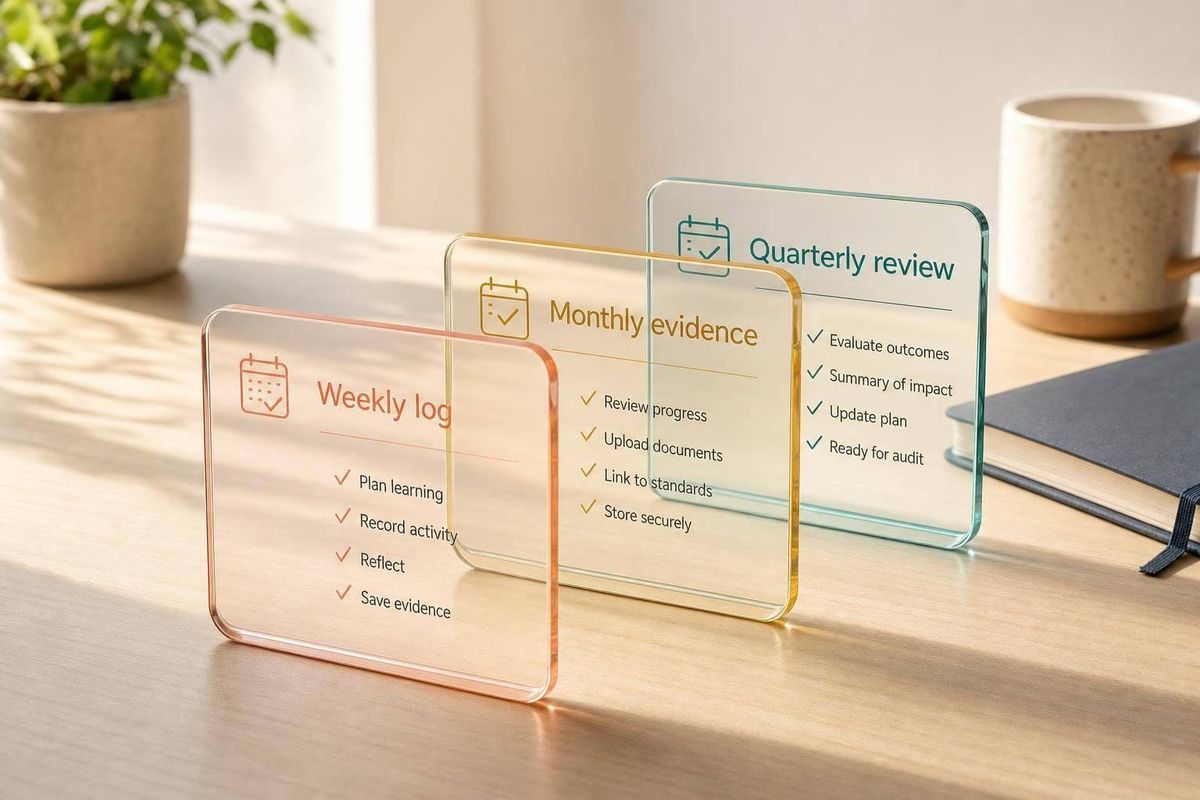
If I want HCPC CPD to stop becoming a last-minute panic, I need to do three things: log it weekly, file evidence monthly, and review it every few months. That is the short answer.
HCPC audits 2.5% of registrants per profession in each renewal cycle, so I cannot assume I will never be picked. The article makes one point clear: I do not need more CPD. I need a clear record, at least two types of learning, and short notes that show what changed in my work and who that helped.
Here is the article in one glance:
- I need to meet five HCPC CPD standards
- I should keep records across the full two-year cycle
- I only need two or more learning types, not every type
- I should link CPD to my role, appraisal and PDP
- I should keep evidence for 4 to 6 strong activities
- If audited, I may need:
- a ~500-word practice summary
- a CPD list with around 12 to 50 entries
- a ~1,500-word personal statement
- evidence for selected activities
- HCPC says profile processing often takes 8 to 12 weeks
What I take from this is simple: small updates beat a big catch-up. A short note after a case discussion, training session, journal read, or supervision meeting is far easier than rebuilding two years of CPD from memory.
If I keep one personal log, store anonymised evidence in one place, and write in first person, I am far more likely to be ready if an audit notice lands.
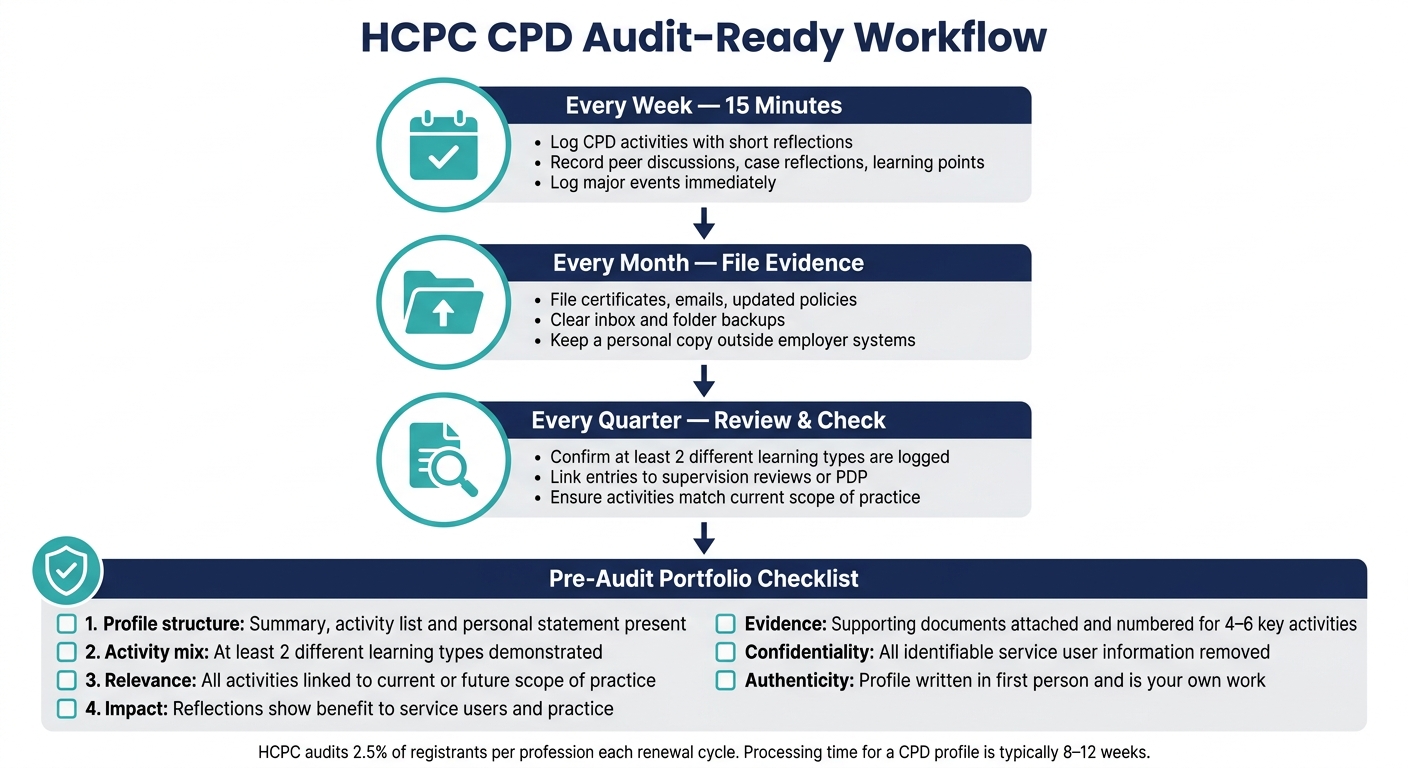
HCPC CPD Audit-Ready Workflow: Weekly, Monthly & Quarterly Routine
Your guide to CPD profiles and audits | #CPDWeek2026
Start Your Guided Reflection Today
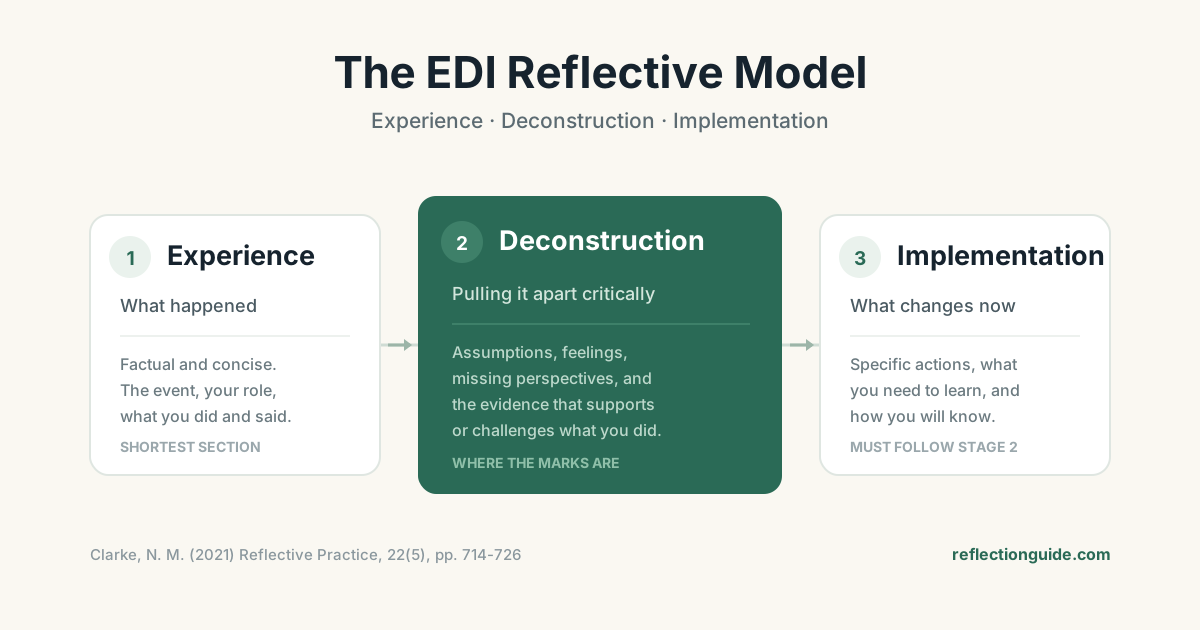
Create structured, CPD-ready reflections using recognized models like Gibbs, Driscoll, Kolb, and ERA. Perfect for NMC revalidation, HCPC CPD, and GMC appraisal.
Start Reflecting Now1. Understand exactly what HCPC requires
HCPC’s five standards make CPD much easier to handle than it first sounds. At heart, the process is simple: keep learning, keep a record, show what changed, and have your evidence ready. In day-to-day terms, that means keeping a continuous record across your two-year registration cycle, using more than one type of learning, showing how that learning affects your practice and service users, and sending a written profile if you’re audited [1].
Here’s what each standard means in plain English:
- Standard 1 - Keep a continuous, up-to-date and accurate record throughout your two-year registration cycle.
- Standard 2 - Include at least two different types of activity relevant to your current or planned scope of practice.
- Standard 3 - Show that your CPD improves the quality of your work, such as by building new skills or increasing confidence.
- Standard 4 - Show how your learning benefits service users - defined broadly as anyone affected by your work, including patients, clients, students or the team you manage.
- Standard 5 - If audited, submit your own written profile [1].
The easiest way to stay on track is to use these five standards as a filter. Before you spend time on any CPD activity, ask yourself: does it fit one of these standards, and will I be able to show that later?
What counts as CPD in day-to-day practice
This is where many people overthink it. CPD doesn’t only mean courses or formal study. HCPC accepts five broad learning types, and a lot of them already happen as part of normal working life.
| CPD Category | Day-to-Day Examples |
|---|---|
| Work-based learning | Reflective practice, clinical audit, work shadowing, in-service training, supervising staff or students, case studies |
| Professional activity | Mentoring, involvement in a professional body, giving conference presentations, acting as an examiner |
| Formal education | Formal courses, research, distance or online learning, seminars |
| Self-directed learning | Reading professional journals or articles, reviewing books, internet-based research |
| Other | Relevant voluntary work or public service |
You don’t need to do everything on this list. In fact, using just two different types of learning is enough to meet Standard 2. For example, reading a journal and attending in-service training would count [2].
What an HCPC audit asks you to submit
If you’re selected for audit, you submit your profile through your online HCPC account, and CPD assessors review it. Once submitted, the average processing time for a CPD profile is eight to twelve weeks [3].
A complete audit profile will usually include:
- a summary of your recent practice of around 500 words
- a list of CPD activities from the past two years, typically between 12 and 50 entries
- a personal statement of approximately 1,500 words explaining how your activities met the five standards
- evidence for four to six activities, such as certificates, meeting notes, testimonials or redacted reports [4]
"A CPD profile is a representative selection of the CPD you've undertaken in the past two years, which we will ask you to submit if you are audited." - Mark Robinson, Registration Manager, HCPC [4]
It helps to keep everything in one place as you go, whether that’s a digital folder or a paper file. That way, if you’re audited or move jobs, you won’t be left scrambling to pull your evidence together [5].
Once you know what HCPC wants, the next step is recording evidence as you go.
2. Plan CPD activities that meet standards and save time
Good CPD planning means picking activities that support your role, your appraisal goals and HCPC standards at the same time. That helps you avoid doing the same admin twice and keeps your record under control. The goal isn't to do more CPD. It's to do better CPD that's easier to record and explain.
Match CPD to your role, appraisal goals and learning needs
Start with the documents you already have. Your job description shows which skills matter in your day-to-day work. Your supervision notes and personal development plan (PDP) point to gaps that have already been flagged. When CPD links back to your role, it's much easier to justify because you can show why you picked it and what changed in practice [5] [6].
"You are able to make your own decisions about the CPD that is most beneficial to your service users, your practice and your future career ambitions." - HCPC [1]
Assessors want to see relevance and impact, not just proof that you turned up. That's the key point. An activity is much easier to defend when you can tie it to a supervision note or an appraisal target that shows why it mattered [1] [6].
Build a balanced annual plan instead of collecting activities at the last minute
Spreading CPD across your two-year registration cycle is far less stressful than scrambling to plug gaps in the final months before renewal. A simple way to do this is to line up your CPD calendar with your employer's appraisal cycle and your HCPC renewal period.
The table below shows how different activity types compare for time and value in your HCPC profile. It can help you decide where to put your effort over the year.
| Activity Category | Typical Time Investment | Usefulness for HCPC Standards |
|---|---|---|
| Work-based Learning | Low to medium (daily/weekly) | High: directly shows impact on practice and service users |
| Professional Activity | Medium to high (occasional) | High: shows involvement in the wider profession and leadership |
| Formal Education | High (scheduled) | Medium: structured knowledge, but needs reflection to show impact |
| Self-directed Learning | Low (ongoing) | Medium: helps you stay current; works best alongside other types |
A little, often, tends to work best. A short reflection after a complex case or a quick note from a team meeting where you used something new can go a long way [5].
Use planning tools to cut duplication
A simple CPD planning template can save a lot of time. Before you start an activity, jot down:
- your objective
- the activity type
- what you expect to learn
- who will benefit, and how
- what evidence you'll keep
That only takes a few minutes, but it can save a lot of digging later.
Reuse supervision notes, PDPs and appraisal records in your CPD plan so you don't create extra paperwork for yourself [6]. The HCPC reflective practice template and scope-of-practice template can help keep entries consistent and focused on impact [7] [8]. You can also use the same notes to build your CPD log as you go.
Once your plan is in place, log each activity straight away so your evidence stays complete.
3. Record CPD with logs, templates and organised evidence
Once your plan is set, turn each activity into a short log entry and keep the evidence with it. The aim is simple: use one record to track CPD as you go, then pull from that same record for appraisal and supervision [1] [5].
Set up a CPD log that matches HCPC expectations
The HCPC does not require one set format, so you can use a binder, folder, spreadsheet or digital tool [1] [5]. The format matters less than the detail you record. For each activity, include the date, activity, source, time spent, CPD type, learning outcome, impact on practice, service-user benefit, evidence link [1] [6].
"If your record of CPD activities includes a place where you write about how you will use the knowledge you have gained, then this could be useful evidence." - HCPC [6]
Write up each activity on the same day if you can. A few lines done straight away are usually more accurate, and far easier to use later, than trying to piece things together months afterwards [5].
A tidy log helps, but it works best when the evidence behind it is just as easy to trace.
Store digital and paper evidence so it is easy to find later
Keep evidence filed by cycle and activity type. A simple setup like Cycle > Work-based Learning > Supervision Review makes it much easier to pull out examples if you ever need them for audit. If you are audited, the HCPC asks for a summary of activities from the previous two years, plus supporting evidence for a selection of those activities, not your full archive [1] [5].
Useful evidence can include:
- Certificates
- Emails confirming attendance
- Case studies
- Testimonials
- Induction materials
- Personal development plans
- Adapted documents from appraisals and supervision reviews [6]
If anything relates to a case, anonymise it before adding it to your record. Remove patient or service user names, along with any other details that could identify them [6]. It also helps to keep files in a personal location, not only on your employer's system, so you can still get to them if you move jobs [5].
Choose a recording method you will actually keep using
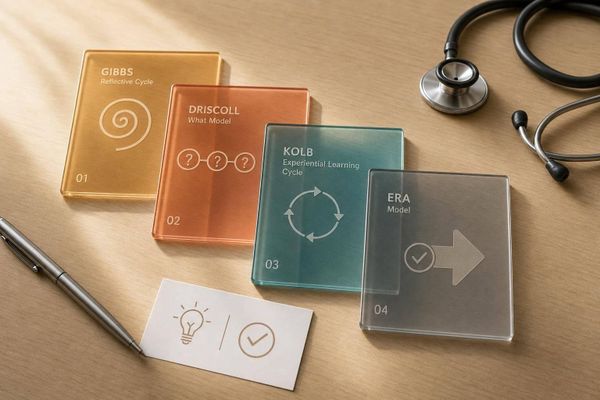
The best method is the one you will stick with. If a system feels like a chore, chances are it will get ignored. Three common options are below.
| Recording Method | Time Efficiency | Organisation | Privacy and access | Audit readiness |
|---|---|---|---|---|
| Paper Notebook | High for quick notes; low for compiling | Can become bulky; hard to search | High privacy; low accessibility if lost or left at work | Moderate - requires scanning/copying |
| Spreadsheet | Moderate; manual entry required | High - easy to filter by date or category | Moderate - needs password protection and backup | High - easy to export or print |
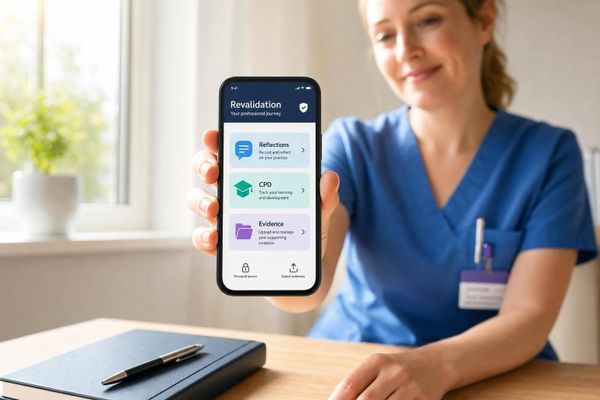
| Dedicated Digital Platform | High - often includes mobile apps | Very high - automated categorisation | Variable - depends on provider | Very high - often features export-ready profiles |
"This is your personal record, and you can keep it in whatever way is most convenient for you." - HCPC [5]
Pick the format that makes the habit easy to keep. Record small amounts often, attach evidence to each entry, and keep a personal copy that stays with you if your job changes.
4. Build an audit-ready HCPC CPD profile
Turn your log into a profile by picking the strongest 4 to 6 entries. Your CPD log is the raw material. The profile comes from smart selection, not from rebuilding everything from scratch.
Select activities and evidence that show relevance, variety and impact
In your personal statement, cover 4 to 6 representative activities. Pick entries that, together, show at least two different types of learning - for example, a peer review session alongside a self-directed reading programme - to meet Standard 2 [1] [4].
Number each piece of evidence so the assessor can match it straight to the right part of your statement. Certificates, updated protocols, redacted case studies and testimonials can all help. What matters most is this: the evidence should show the effect of the learning, not just prove that the activity took place [6].
"You are able to make your own decisions about the CPD that is most beneficial to your service users, your practice and your future career ambitions." - HCPC [1]
Use the same log-and-evidence system throughout so the profile stays easy to update.
Write short reflective statements that answer the assessor's questions
Each chosen activity needs a short reflective account in your personal statement. A simple way to do this is to answer four prompts: what you did, what you learned, how your practice changed, and how service users benefited [1]. Use 'I' throughout so your own development is clear [4].
If something did not go to plan, don't leave it out. HCPC makes the point that reflection still counts when an activity fell short. What matters is showing why it was less useful than expected, and what you would change next time [1].
"The important thing is to consider why the activity was not as helpful as you thought it would be, and how you might do things differently in future." - HCPC [1]
Avoid the common weaknesses that make profiles harder to defend
Profiles that run into trouble at audit tend to have the same weak spots: vague wording, no direct link to practice, or evidence that is missing or doesn't match what the statement says. Small tweaks in wording and evidence choice can make a big difference.
| Profile element | Weak | Strong |
|---|---|---|
| Activity description | "Read professional journals." | "Read an article in [Journal Name] regarding [Specific Topic] and applied the findings to [Specific Practice Area]." |
| Impact on practice | "I learned a lot." | Explains how the learning led to a specific change in practice or improved confidence in a technique, and how a workflow change reduced wait times or improved the quality of patient information. |
| Evidence | Unorganised pile of certificates. | Numbered evidence linked to specific reflections, fully anonymised where required. |
Once the profile content is written, tighten the evidence trail.
Submit copies, not originals. Remove all identifiers from case-related material, including names, initials and addresses [6] [4].
5. Keep CPD on track all year and stay ready for audit
Use weekly and monthly routines to keep your record up to date
Once your log and evidence are set up, the goal is simple: keep them current with small, regular updates.
Set aside 15 minutes each week to log activities and add short reflections while the details are still clear. That could be a brief peer discussion, a service-user reflection, or another learning point from your week. If something major happens, record it straight away.
Then, once a month, file your evidence before it disappears into your inbox or gets buried in a folder. This can include:
- certificates
- emails
- updated policies
Every quarter, review your log and make sure it still shows at least two learning types and activity that fits your role. Where you can, link entries straight to workplace documents like supervision reviews or your personal development plan (PDP) to cut duplicate admin [6]. And keep a personal backup outside your employer's system.
Get this rhythm in place and the final check can take only a few minutes.
Run a simple portfolio checklist before renewal or audit
Before renewal - or if an audit notice lands - do a quick profile check.
| Checklist Category | What to Verify |
|---|---|
| Profile structure | Summary, activity list and personal statement present |
| Activity mix | At least two different types of learning demonstrated |
| Relevance | All activities linked to current or future scope of practice |
| Impact | Reflections show how learning benefited service users and improved practice |
| Evidence | Supporting documents attached and numbered for the 4–6 key activities |
| Confidentiality | All identifiable service user information removed |
| Authenticity | Profile written in first person ("I") and is your own work |
"A CPD profile is a representative selection of the CPD you've undertaken in the past two years... It's a chance for you to show us how much work you've put in to maintaining your CPD." - Mark Robinson, Registration Manager, HCPC [4]
Conclusion: A clear, efficient CPD workflow for HCPC professionals
Weekly logging, monthly evidence capture, and a quarterly review keep your CPD ready for audit without a last-minute scramble. Understand the standards early, plan activity that fits your practice, keep a running log, organise evidence as you go, and check your portfolio against the list above. None of these steps is hard on its own, but done on a steady basis, they turn audit prep from a headache into a normal part of the job.
FAQs
How much CPD is enough for HCPC?
The HCPC doesn’t set a fixed number of hours or a set amount of CPD. Instead, it expects you to keep learning on a continuous basis, with activity that fits your current role or the kind of work you plan to do next.
Across your two-year registration cycle, you need to complete at least two different types of learning activity. If you’re audited, you’ll need to submit a personal statement and 4 to 12 pieces of evidence to show how your CPD improved your practice and benefited service users.
What if I have gaps in my CPD record?
If you’re selected for an audit, you’ll need to provide a dated list of all professional development activities you’ve completed since your last registration renewal.
If your record includes gaps of three or more consecutive months, you’ll need to explain them. Clear explanations help show that your record is accurate and up to date.
What evidence is strongest for an HCPC audit?
The strongest evidence shows how your CPD activities changed your day-to-day work and helped service users.
So don’t send a huge pile of paperwork. It’s better to choose 4 to 12 relevant pieces that back up your personal statement.
Useful evidence can include:
- case studies
- reflective notes
- feedback from peers or service users
- action plans
- meeting records with managers about new skills
- evaluations of courses or projects
Pick the items that best show what you learned, how you used it, and what changed as a result.