GPhC Revalidation: What Pharmacists Need to Submit
GPhC revalidation checklist: submit 4 CPD (≥2 planned), 1 peer discussion and 1 reflective account via myGPhC two months before expiry.
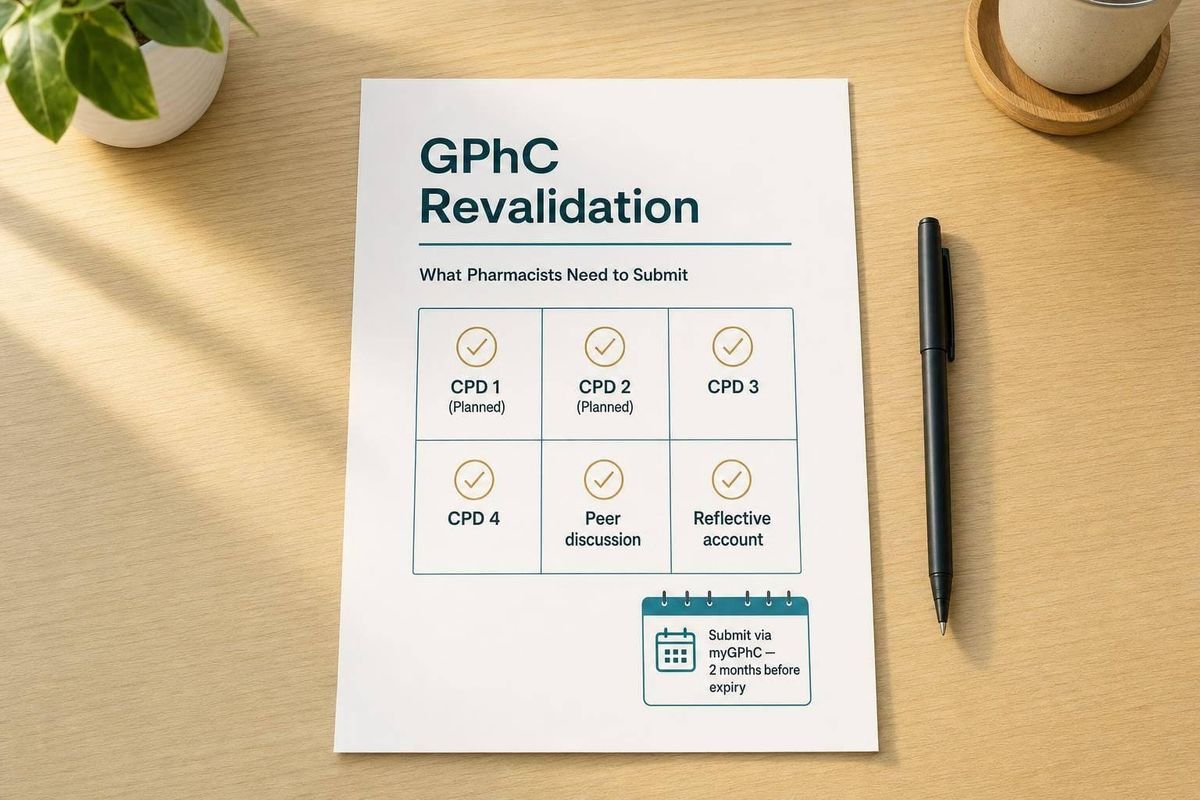
If I’m renewing my GPhC registration in 2026, I need to submit 6 records each year: 4 CPD records, 1 peer discussion, and 1 reflective account. I must do this through myGPhC at least 2 months before my registration expiry date, and from 1 January 2026 I can link my reflective account to any of the 9 Standards for Pharmacy Professionals.
Here’s the short version:
- 4 CPD records
- At least 2 must be planned
- Up to 2 can be unplanned
- 1 peer discussion
- Must be a real-time conversation
- Phone, video, or face-to-face is fine
- Email or text does not count
- 1 reflective account
- Must link to one or more of the 9 standards
- From 01/01/2026, I can choose any of the 9
- Deadline
- Submit everything at least 2 months before expiry
- Privacy
- Do not include patient-identifiable or confidential details
That means the core rule is still the 4-1-1 model. The only 2026 update is the reflective account rule, which gives me more choice when I write about my practice.
A few points matter most when I prepare my records:
- CPD entries should show change, not just attendance
- Peer discussion should show what I took from the conversation
- Reflective accounts should link my day-to-day work to the standards
- All records should be anonymised and ready for review
One easy way to think about it: if I can show what I learned, what changed, and how I kept details private, I’m covering the main points the GPhC asks for.
Revalidation for pharmacy professionals providing assurance and improving quality (longer version)
Start Your Guided Reflection Today
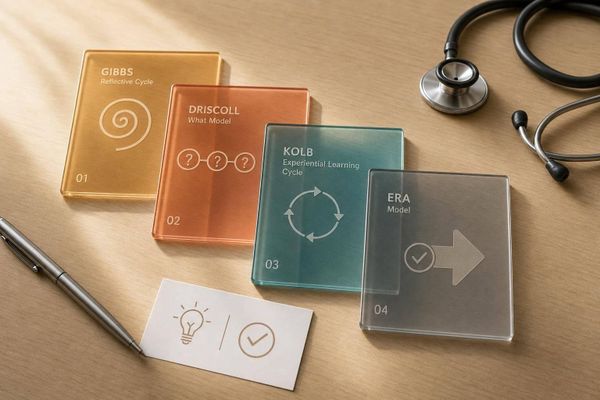
Create structured, CPD-ready reflections using recognized models like Gibbs, Driscoll, Kolb, and ERA. Perfect for NMC revalidation, HCPC CPD, and GMC appraisal.
Start Reflecting NowGPhC revalidation: the 3 records you need each year
Use the 4-1-1 structure: four CPD records, one peer discussion and one reflective account. There’s no official word limit, but entries that meet the rules tend to come in at about 400 words. The notes below set out what each record needs.
CPD records: 4 per year, at least 2 must be planned
You need four CPD entries each year, and at least two must be planned. Planned learning is something you choose in advance to deal with a gap in your knowledge or skills, like a course or some focused reading. Unplanned learning happens through day-to-day work, such as a patient query or an incident at work.
The GPhC puts it simply:
"You'll need to complete four CPD entries a year. At least two of these must be planned... The rest can be unplanned." [1]
Each entry should make one thing clear: what changed because of the learning. Don’t just list what you did. Show how it helped your patients, colleagues or the public.
Peer discussion record: 1 real-time conversation with a trusted peer
This record is based on one open, honest conversation in real time. That can be face-to-face, over the phone or on a video call. Email and text exchanges don’t count.
Your peer does not have to be a pharmacist. They do need to understand your work well enough to give an objective view. In your record, you’re writing a summary, not a word-for-word transcript. Include:
- who you spoke with
- how the discussion took place
- what, if anything, changed in your practice afterwards
Reflective account: 1 record linked to the Standards for Pharmacy Professionals
The reflective account needs less detail than the other records, but it has to show a clear link to your day-to-day work.
Explain your practice setting and show how your work meets one or more of the GPhC’s Standards for Pharmacy Professionals. From 1 January 2026, you can choose any of the nine standards, instead of being limited to the ones set by the GPhC.[2] Pick the standard or standards that best fit what you do in practice.
Never include patient-identifiable or confidential information. Anonymise clinical details before you write them up.
What to include in each GPhC submission
The aim is simple: turn the 4-1-1 rules into records that show relevance and impact.
How to write CPD records that meet the planned and unplanned requirement
Each CPD entry needs to show what you did, why it mattered, what you learned, and how it changed your practice. The GPhC is looking for a clear benefit to patients or the public, not just proof that you attended a session or read an article.[1]
Here’s how planned and unplanned entries differ in day-to-day practice:
| Planned CPD | Unplanned CPD | |
|---|---|---|
| Intent | Learning identified in advance to address a known gap | Spontaneous learning triggered by a day-to-day event |
| Typical activity | Training course, workshop, focused clinical reading | Complex patient query, staff meeting, reflecting on an error |
| Annual quota | Minimum 2 of your 4 entries must be planned [1] | Maximum 2 can be unplanned [1] |
A good way to keep this manageable is to draft your entries in the GPhC Word templates first, then move the final version into myGPhC.
How to document a peer discussion and its effect on practice
A peer discussion is a live conversation with a trusted peer about your learning and practice.[1]
When you write it up, identify your peer by role, not by name. For example, you might write “a senior clinical pharmacist at a neighbouring trust” or “my superintendent pharmacist”. Then explain, in a few lines, why that person was suitable, what you discussed, and how the discussion shaped or reinforced your practice.[1]
"You'll need to show how your learning has benefitted people, so make sure you carry out your peer discussion in plenty of time." - General Pharmaceutical Council [1]
That timing matters. If you leave the discussion too late, you may not have time to spot any change in your practice before submission. Have the conversation early, notice what shifted, then record that effect before you upload anything.
How to draft a reflective account without disclosing confidential information
Keep your practice setting broad. Describe your role, the type of service you provide, and the sort of patient group you work with, but don’t name your employer or any person.[1] Then link your example to one or more of the nine Standards for Pharmacy Professionals so it’s clear how your day-to-day work connects to them.[2]
If you use a specific case, remove anything that could point to an individual. Swap patient names for neutral terms such as “Patient X”. Leave out branch numbers, exact locations, and other details that could give the person away.[1] A useful rule of thumb is this: if someone could still work out who it was, anonymise it more.
Use ReflectionGuide to draft the reflective account, and check that GPhC is listed as a supported regulator before you start.
Once your drafts are ready, move the records into myGPhC and check the portal requirements before submitting.
How to submit through myGPhC and avoid common errors
Once your six records are drafted, the last job is to upload them properly in myGPhC. You need to submit your 4 CPD records, peer discussion, and reflective account through myGPhC as part of your annual renewal.
Submission timing: the annual cycle and the two-month deadline
Start with your renewal date, then work backwards and leave yourself enough time to fix any mistakes. If you miss the two-month deadline, you could be removed from the register.[3] In plain terms, all six records need to be ready before renewal.
The safest way to handle this is to build your records across the year. Log CPD as you go, while the detail is still clear in your mind, instead of leaving everything until the deadline.
Confidentiality, accuracy, and review readiness
Before you submit, give every record a final check for accuracy and confidentiality. Treat each one as something that could be reviewed. Keep the writing factual, professional and anonymised, and make sure no identifiable details are left in place.
Before you upload, check for clarity, accuracy and consistency.
GPhC vs NMC revalidation: key differences and a final checklist

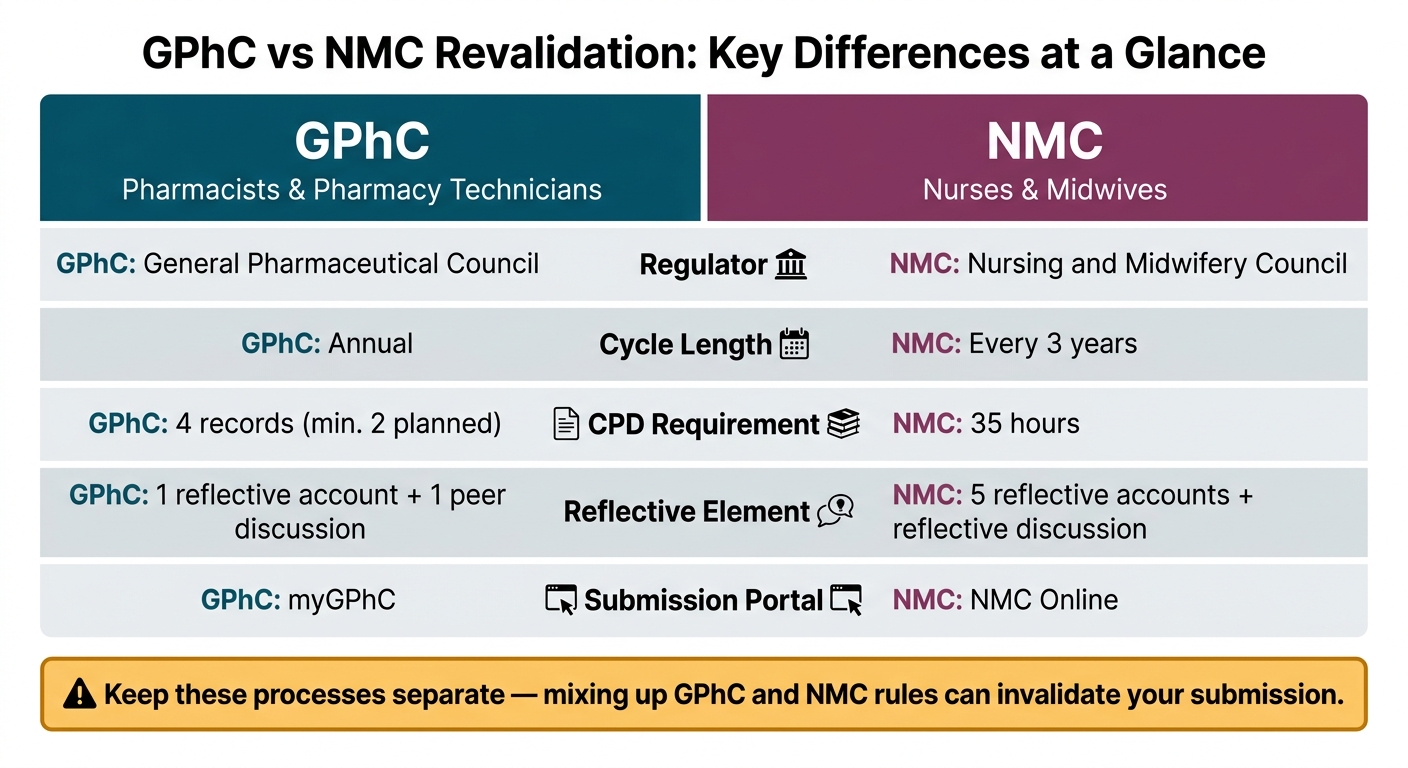
GPhC vs NMC Revalidation: Key Differences at a Glance
GPhC and NMC revalidation are not the same process
Before you submit in myGPhC, keep GPhC and NMC separate in your mind. They are different processes with different cycles, records and portals. If you mix them up, you could end up with a submission that doesn't meet the GPhC rules.
Use the comparison below for one reason only: to stop NMC rules slipping into your GPhC renewal.
| Feature | GPhC (Pharmacists and pharmacy technicians) | NMC (Nurses and midwives) |
|---|---|---|
| Regulator | General Pharmaceutical Council | Nursing and Midwifery Council |
| Cycle length | Annual | Every 3 years |
| CPD requirement | 4 records, at least 2 planned learning[3] | 35 hours[3] |
| Reflective element | 1 reflective account + 1 peer discussion[3] | 5 reflective accounts + reflective discussion[3] |
| Submission portal | myGPhC | NMC Online |
See our NMC revalidation guide for a complete walkthrough of that process.
For your GPhC renewal, the checklist below is the part to focus on.
Final checklist: what to submit before your renewal date
For reflective accounts from 1 January 2026, you can use any of the nine Standards for Pharmacy Professionals.
Before you renew, all records must be submitted through myGPhC at least two months before your registration expiry date.
| Requirement | Quantity | Key condition |
|---|---|---|
| CPD records | 4 | At least 2 must be planned learning |
| Peer discussion | 1 | A real-time conversation with a trusted peer |
| Reflective account | 1 | Linked to any of the nine Standards for Pharmacy Professionals from 1 January 2026[2][1] |
| Submission portal | myGPhC | All records entered before renewal[3] |
| Deadline | Annual | At least 2 months before registration expiry[3] |
| Confidentiality | Mandatory | No patient or third-party identifiers |
Use ReflectionGuide to draft your reflective account, then check that GPhC is listed as a supported regulator before publishing.
FAQs
Who can be my peer?
Your peer can be anyone you trust and respect. As the GPhC puts it, a peer discussion is an open and honest conversation about your practice and learning.
It can happen face to face, over the phone, on a video call, or in any other live format. The key point is simple: you should be able to show how that discussion led to clear outcomes for patients and other service users.
What counts as planned CPD?
Planned CPD is learning you choose ahead of time to fill a clear gap in your knowledge or skills.
That might mean going on a training course or doing research before taking on a new requirement in your practice. For GPhC revalidation, you must submit at least two planned CPD records each year.
What happens if I miss the deadline?
If you miss the submission deadline, or your records don’t meet the core requirements, you could be removed from the GPhC register and may not be able to practise.
The GPhC will usually give you a chance to submit your records or revise them. If exceptional circumstances mean you can’t submit on time, contact the GPhC through your myGPhC account to ask for an extension or a reduction in the number of entries.