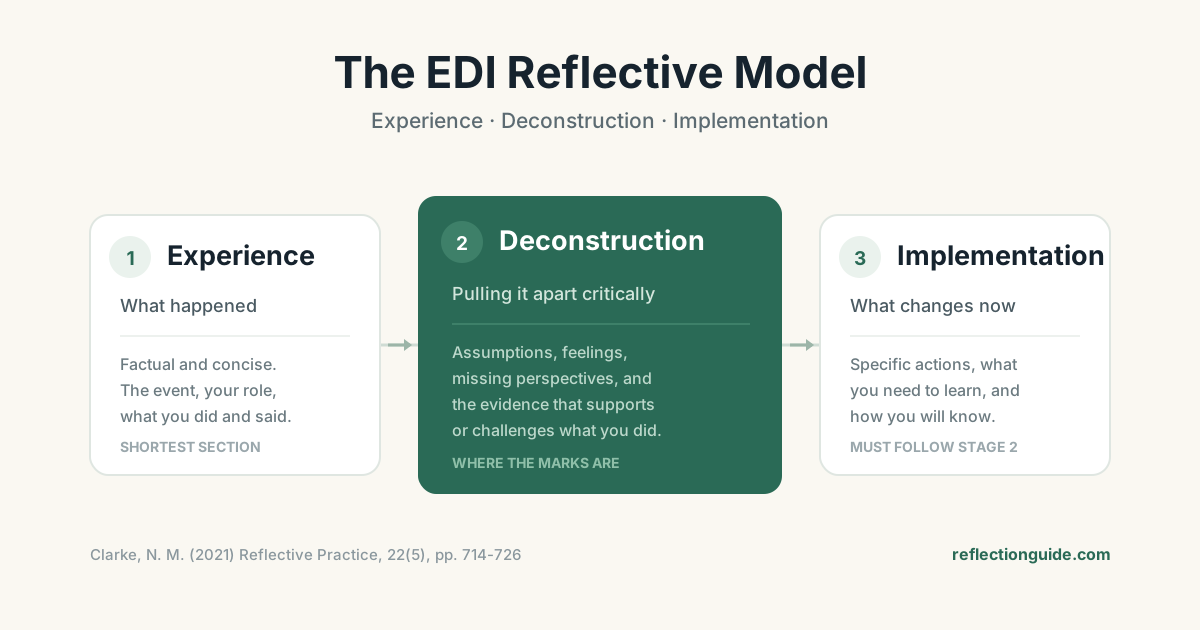
How to Maintain Confidentiality in Reflective Writing
Anonymise reflective notes and store them securely to meet UK professional standards and protect patients.
Maintaining confidentiality in reflective writing is essential for healthcare professionals in the UK. Whether you're completing revalidation, CPD audits, or appraisals, reflections must safeguard patient and colleague privacy. Here’s what you need to know:
- Confidentiality vs. Anonymity: Confidentiality means protecting private, identifiable information. Anonymity involves removing all identifiers to reduce identification risks.
- Regulatory Standards: Bodies like the NMC, HCPC, and GMC require anonymised, professional reflections that avoid specific names, dates, or locations.
- Identifiable Information: Even indirect details (like rare conditions or unique events) can breach anonymity. Always remove or generalise such information.
- Practical Tips: Use pseudonyms, broad timeframes, and general descriptions. Focus on lessons learned rather than detailed event narratives.
- Storage: Securely store reflections, keeping them separate from clinical records. Avoid sharing sensitive details unnecessarily.
MDU webinar: introduction to confidentiality
Start Your Guided Reflection Today
Create structured, CPD-ready reflections using recognized models like Gibbs, Driscoll, Kolb, and ERA. Perfect for NMC revalidation, HCPC CPD, and GMC appraisal.
Start Reflecting NowCommon Risks to Confidentiality in Reflective Writing
Regulatory expectations highlight the importance of recognising and addressing risks in reflective writing. Without careful attention, reflective notes can unintentionally disclose identifiable information. Being aware of these risks is the first step in preventing such disclosures.
How Identifiers Can Compromise Anonymity
While removing patient names is standard practice, indirect identifiers often slip through unnoticed. Details like rare medical conditions, unusual clinical scenarios, or specific locations can inadvertently reveal someone's identity. Even seemingly harmless details, when combined, can make identification possible. Liz Price, Senior Risk Adviser at MDDUS, emphasises this point:
"Be aware that even when an SER [Significant Event Review] has been anonymised there may still be the risk of a patient being identifiable when clinical/personal circumstances are rare or unusual." [1]
The risk isn't limited to patients. Colleagues can also be identified if specific job titles or unique roles are mentioned. Additionally, non-clinical details, such as personal or family circumstances, can pose similar risks [2]. This underlines the importance of understanding these risks and using precise anonymisation techniques, which will be explored further.
Risks When Sharing Reflective Notes
Sharing reflective notes increases the chances of unintended disclosure. These notes are legally accessible, making proper anonymisation essential. NHS England advises:
"Whatever is committed to a written format may be accessible to a court of law so all professional documentation, including reflections, should be written in a professional manner." [3]
Under data protection laws, patients have the right to request access to reflective notes if they contain identifiable information. This makes thorough anonymisation a crucial step before sharing any reflections.
Safe vs Risky Content: A Comparison
| Content Area | Safe to Include | Risky - Avoid |
|---|---|---|
| Patient identity | Pseudonyms or random labels ("Patient A") | Real names, initials, NHS numbers, or exact dates of birth |
| Clinical details | General descriptions of care or the learning event | Rare diagnoses, unusual cases, or unique treatments |
| Dates and times | Broad timeframes ("in spring 2024") | Specific admission dates or exact times of incidents |
| Location | General settings ("a community clinic") | Named wards, specific units, or uniquely identifiable facilities |
| Colleagues | General roles ("a senior colleague") | Specific names, job titles, or roles that could identify individuals |
| Tone | Professional, neutral, and objective language | Emotive, judgmental, or overly personal statements |
| Focus | Lessons learned and future practice changes | Detailed narratives containing identifiable information about third parties |
To protect confidentiality, it's vital to maintain a professional tone and focus on the lessons learned rather than recounting specific events. The techniques in the next sections will help mitigate these risks effectively.
Practical Anonymisation Techniques
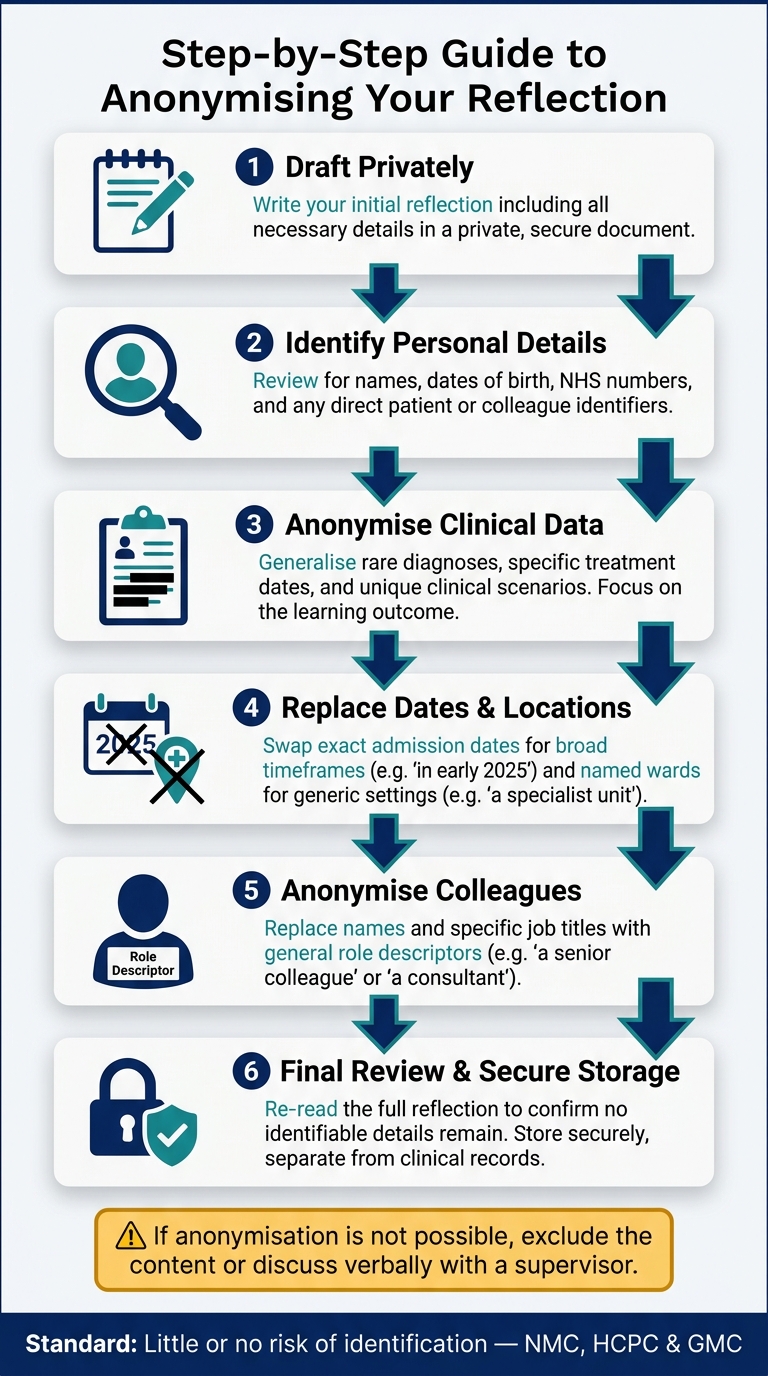
Step-by-Step Guide to Anonymising Reflective Writing for UK Healthcare Professionals
When reflecting on experiences for portfolios, appraisals, or submissions, it’s crucial to address the risks of including sensitive details. Consistently removing or altering identifiable information ensures compliance and protects confidentiality.
How to Use Pseudonyms Correctly
Substitute real names with neutral terms like "Patient A" or "Mr B" for individuals, and use general descriptors such as "a senior nurse" or "a consultant colleague" for staff. For organisations, avoid specific names and opt for phrases like "a community clinic" or "a secondary care setting."
NHS England underscores this responsibility:
"Diligent anonymisation of all written material in appraisal is as important for the writer as for others. It is essential to ensure that third parties, be they patients or colleagues, cannot be identified." [3]
Always clarify at the outset that identifiers have been altered to maintain transparency and compliance.
Step-by-Step Guide to Anonymising Your Reflection
Begin by drafting your reflection privately, including all necessary details. Then, refine it into an anonymised version that focuses solely on learning outcomes [3].
When reviewing your work, systematically address each category of identifiable information:
| Category | Remove/Alter | How to Anonymise |
|---|---|---|
| Personal details | Names, dates of birth, NHS numbers | Use neutral pseudonyms or general age ranges (e.g., "a patient in their 60s") |
| Clinical data | Rare diagnoses, specific treatment dates | Generalise the condition or focus on the learning outcome |
| Dates and times | Exact admission or incident dates | Use broad timeframes (e.g., "in early 2025") |
| Location | Named wards, specific departments | Use generic terms (e.g., "a specialist unit") |
| Colleagues | Names, specific job titles | Refer to roles only (e.g., "a senior colleague") |
| Media | Photos, videos, audio recordings | Remove entirely from reflective notes |
If anonymisation isn’t possible, exclude the content or discuss it verbally with a supervisor [3][4]. This approach is particularly important in environments where re-identification risks are higher.
Anonymising Reflections in Specialist Settings
Specialist environments, such as rare disease clinics or rural healthcare teams, pose unique challenges. Even generalised descriptions can inadvertently identify individuals due to the limited pool of cases. In these settings, anonymisation must be even more stringent.
The HCPC advises sharing only the minimum necessary information [4]. If the key learning can be conveyed without clinical details, omit them. For situations where anonymisation still poses risks, consult your Caldicott Guardian, professional body, or medical defence organisation before documenting anything [3]. As the HCPC highlights:
"Anonymised information is information about a service user that has had all identifiable information removed from it and where there is little or no risk of a service user being identified from the information available." [2]
The standard isn’t just "unlikely to be identified" - it’s little or no risk. This higher threshold demands extra diligence, particularly in specialist settings. When unsure, seek advice before proceeding.
Applying Reflective Models Without Breaching Confidentiality
Reflective models like Gibbs and Driscoll offer a structured way to analyse experiences while maintaining confidentiality. By encouraging a shift from detailed storytelling to focusing on lessons learned, these models naturally reduce the likelihood of including identifiable details. This approach helps professionals reflect effectively without crossing ethical or legal boundaries.
Writing About Events Without Revealing Identities
When documenting events, maintaining anonymity is key. Each stage of a reflective model carries its own risks, with the description phase being the most vulnerable to including identifiable information like names, dates, or specific clinical details. To address this, keep descriptions brief and general. For example, replace specifics with phrases like "during a morning clinic" or "a patient with a chronic condition."
As you move into the feelings, analysis, and action plan phases, the focus shifts to your professional insights, emotional responses, and plans for future improvement. These areas don’t require identifiable details. For particularly sensitive events, consider writing your initial thoughts privately. Then, extract only the professional insights for formal documentation, keeping emotional processing separate. As the HCPC advises:
"Focus your records on the lessons you have learned from the reflection, and any future actions that you might take as a result." [4]
This ensures that reflections remain professional and aligned with regulatory expectations.
How Reflective Models Align with UK Regulatory Guidance
Reflective models are designed to prioritise learning and development, aligning perfectly with the expectations of UK regulators like the NMC, HCPC, and GMC. These organisations emphasise that reflections should focus on improving practice rather than recounting clinical incidents in detail. [5][4] Since written reflections are not legally protected from disclosure, NHS England advises:
"Ensure that everything you write is couched in professional and neutral terms. Think professional, not confessional and avoid being judgemental of yourself or others." [3]
For incidents involving serious harm, it’s wise to consult a medical defence organisation (MDO) before finalising your reflection. [6] If an event feels too sensitive to document fully, make a brief, general note and discuss the specifics verbally with your appraiser or supervisor. [3] These guidelines reinforce the value of structured reflection tools in maintaining confidentiality.
How Reflection Guide Supports Confidentiality
Our Reflection Guide tool is specifically designed to help you meet these regulatory standards with ease. It incorporates the principles outlined by UK regulators, guiding you through established models like Gibbs, Driscoll, Kolb, and ERA. The tool keeps your focus on learning outcomes rather than the event’s details. Built-in privacy checks highlight any identifiable content, ensuring that your final draft is compliant with confidentiality requirements from the start. This makes the reflection process both effective and secure.
Safe Documentation and Storage of Reflective Notes
Once reflective notes have been anonymised properly, ensuring their secure documentation and storage becomes just as important. Even the most carefully written notes can pose a confidentiality risk if stored on an unprotected device or shared without caution. Safe storage practices are as crucial as anonymisation itself.
Secure Storage: Digital and Physical
For digital reflections, use password protection, avoid unencrypted email exchanges, and steer clear of transferring files via removable media like USB drives. The HCPC provides clear guidance on this:
"You must keep records secure by protecting them from loss, damage or inappropriate access." [7]
When it comes to paper-based reflections, store them in a secure, lockable cabinet or room, following your employer's approved storage policies. Keeping reflective notes separate from clinical documentation ensures better compliance with security standards.
Clinical Records vs Personal Reflective Notes
It's essential to differentiate between clinical records and personal reflective notes. Clinical records are formal documents created for patient care, while reflective notes are tools for professional growth and learning, not for documenting clinical events.
| Feature | Clinical Records | Personal Reflective Notes |
|---|---|---|
| Primary purpose | Direct patient care and treatment history | Professional development and learning |
| Regulatory role | Mandatory legal record of care | Evidence for CPD and revalidation |
| Access | Accessible to the clinical team and the patient | Shared during appraisals, CPD audits, or fitness to practise cases |
Reflective notes should always be stored separately from clinical files to ensure patient information remains secure. This distinction upholds the confidentiality standards discussed earlier.
Sharing Reflections in Academic and Teaching Contexts
When sharing reflections in academic assignments or teaching environments, extra caution is needed. A wider audience increases the risk of confidentiality breaches. The key principle is minimum disclosure - share only what is absolutely necessary, ensuring all personal data is removed before submission. For highly sensitive cases, consider discussing details verbally with a tutor or supervisor first, and include only a general, non-specific reference in any written work. Remember, anything written could potentially be accessed in legal proceedings [3].
The Academy of Medical Royal Colleges highlights this approach, stating that reports should be "held/used/shared only as 'educational tools and not a medical record'." [8]
Conclusion
Keeping confidentiality in reflective writing is a critical professional responsibility. Whether you're a nurse completing your NMC revalidation, an allied health professional submitting CPD records, or a doctor documenting a clinical reflection, the same rules apply: anonymise carefully, write with professionalism, and store your work securely. These actions not only align with regulatory requirements but also support structured professional growth.
As NHS England advises:
"Think professional, not confessional and avoid being judgemental of yourself or others." [3]
This sentiment encapsulates the essence of reflective writing - focusing on what you've learned and how you'll improve, rather than detailing specific individuals or places.
It's also important to remember that reflective writing carries legal implications. NHS England highlights:
"Whatever is committed to a written format may be accessible to a court of law so all professional documentation, including reflections, should be written in a professional manner." [3]
This serves as a reminder to approach reflective writing with care, ensuring it meets ethical and legal standards.
If you're ever unsure about confidentiality, seek advice promptly. Whether it's your professional body, Caldicott guardian, trade union, or a legal adviser, early guidance can help prevent potential breaches. A small step now can save significant issues later.
FAQs
How do I know if a detail is still identifiable?
Details are considered identifiable if they can reveal someone's identity. This includes names, addresses, dates of birth, photos, or any health-related information. It's important to avoid mentioning specific locations, such as hospitals, to maintain privacy. Information is only deemed anonymised when all identifiable elements are removed, leaving minimal risk of someone being identified. If you're uncertain, stick to non-specific references in your writing and consult with your supervisor or appraiser to ensure everything complies with privacy guidelines.
What should I do if I can’t anonymise a case safely?
If anonymising a case poses challenges, it's best to leave out any unnecessary details that might reveal someone's identity. Instead, centre your reflection on what you’ve learned and how it will influence your approach in the future. For particularly sensitive matters, consider making a general note to discuss with your appraiser, who can offer guidance on documenting it properly. If you’re unsure, don’t hesitate to reach out to your professional body, union, or legal adviser for additional support.
Can my reflective notes be requested or used in court?
Yes, courts can request access to reflective notes. Although certain professional organisations might not demand them during their investigations, a judge can still order their disclosure. To minimise potential issues, ensure your notes remain factual, professional, and anonymised, concentrating on the lessons learned. If you're ever asked to disclose these notes, it’s crucial to promptly consult your professional body, union, or legal adviser for guidance.