NMC Revalidation: The Complete Guide (2026)
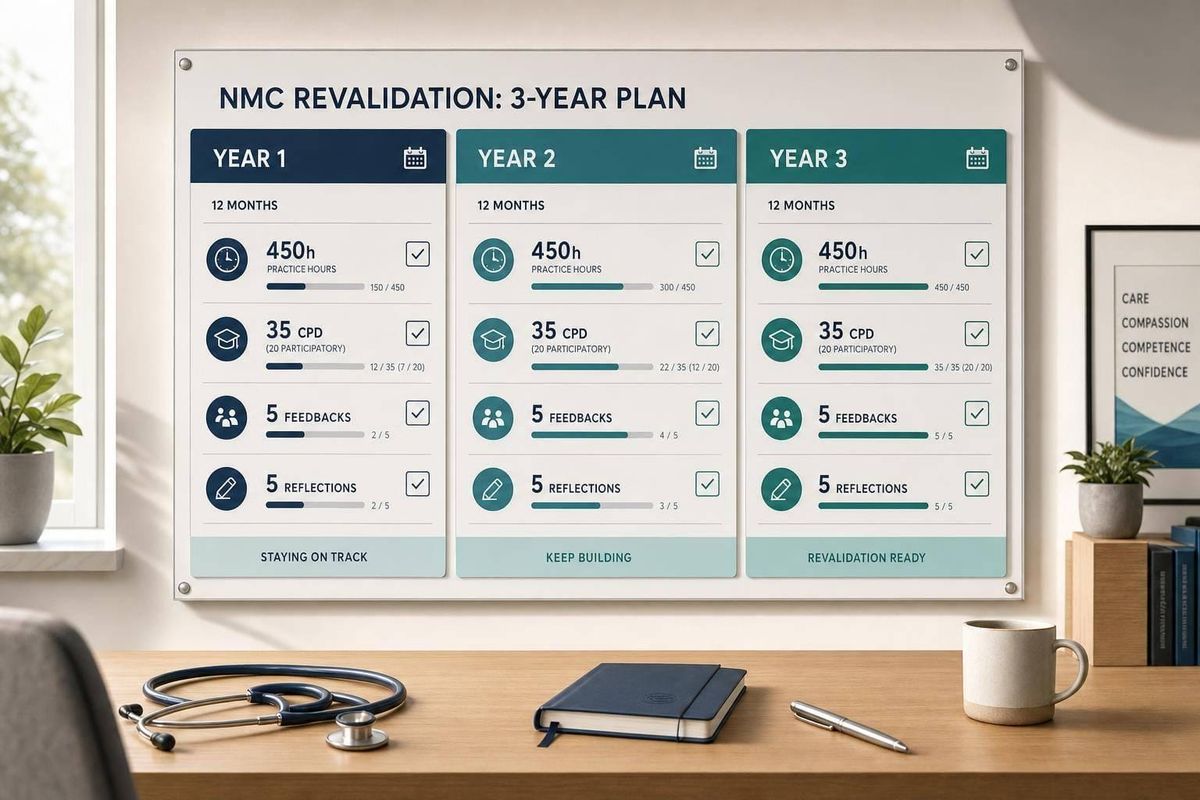
Practical three‑year NMC revalidation plan: log 450 practice hours, 35 CPD (20 participatory), five feedbacks and five reflections.
If I want to stay on the NMC register, I need to meet the full revalidation checklist every 3 years - and most people slip up on records, dates, or the final MyNMC form, not on the work itself.
Here’s the full picture in plain English: I need 450 practice hours for one registration, 35 hours of CPD with 20 participatory hours, 5 pieces of feedback, 5 written reflections, 1 reflective discussion, 1 confirmation, plus health, character and indemnity declarations. I can submit in MyNMC from 60 days before renewal, and I do not upload my evidence when I apply.
Before I go any further, these are the points I’d want in front of me:
- Revalidation runs on a 3-year cycle
- It applies to nurses and midwives in the UK, and nursing associates in England
- It is not a fitness-to-practise test
- I must keep a secure portfolio, paper or digital
- All reflections and notes must be anonymised
- My confirmer checks the evidence before submission
- The NMC may ask to see my records for up to 3 years after submission
- Missing the fee can lead to lapsed registration
A few details matter more than they first seem. At least 4 of the 5 reflections must link to CPD or feedback. My reflective discussion must be with an NMC-registered professional. My confirmer is often my line manager, even if they are not on the NMC register. And one of the most common admin errors is putting my own PIN into the confirmer field in MyNMC.
If I keep my hours, CPD, feedback and reflections up to date across the full cycle, the final step is much easier. That’s the main takeaway from this guide.
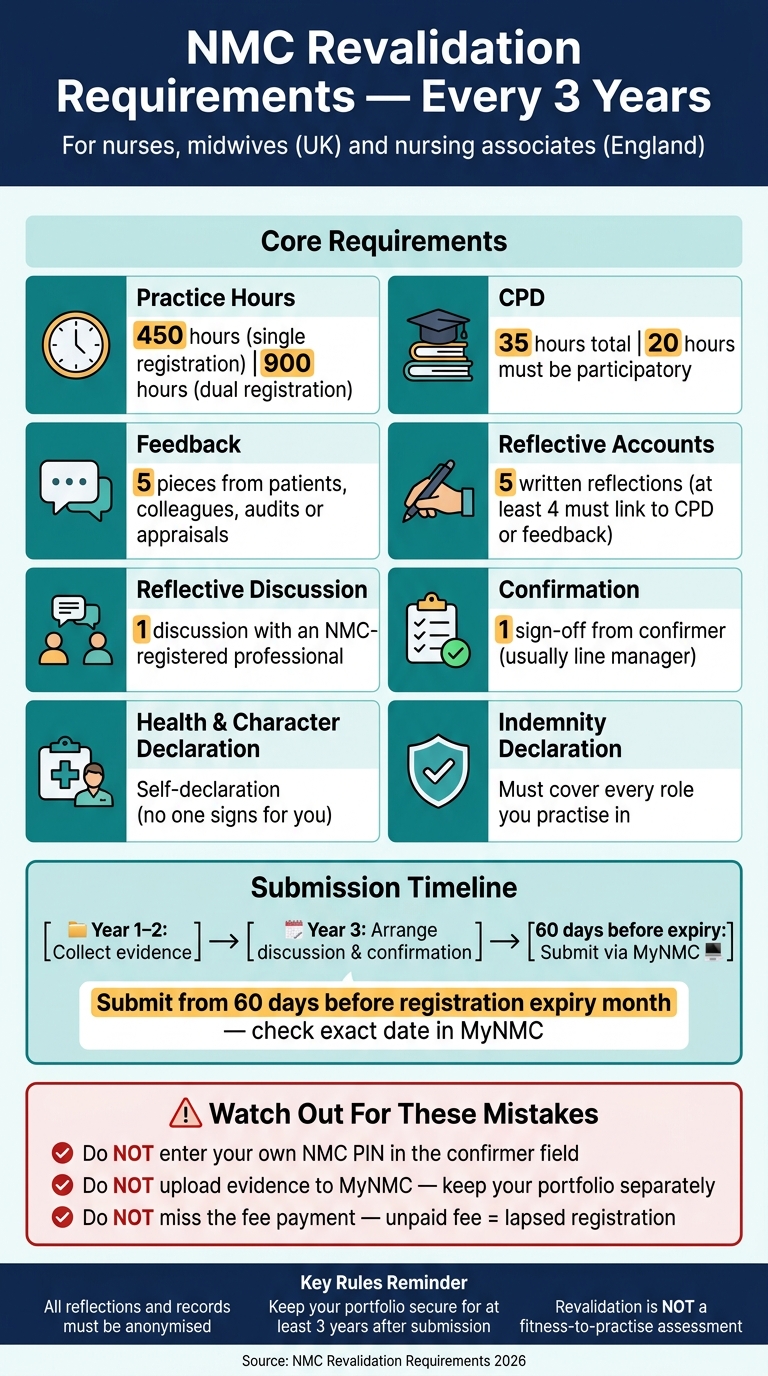
NMC Revalidation Checklist: Every Requirement at a Glance
Complete Guide of NMC Revalidation | Requirements(with examples) + Online Application

Start Your Guided Reflection Today
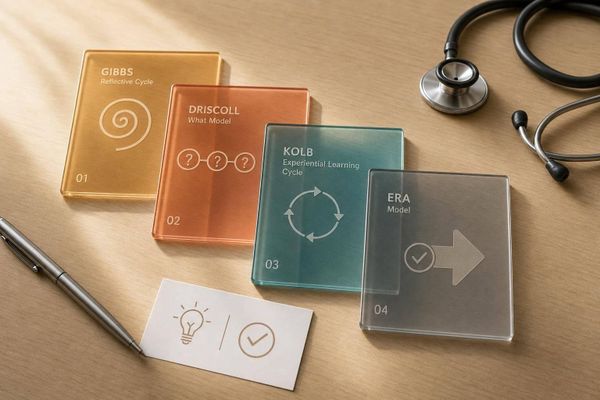
Create structured, CPD-ready reflections using recognized models like Gibbs, Driscoll, Kolb, and ERA. Perfect for NMC revalidation, HCPC CPD, and GMC appraisal.
Start Reflecting NowThe Evidence You Need to Collect Across the 3-Year Cycle
Collect your evidence across the full three-year cycle. Don’t leave it until the last few weeks. As you gather each item, complete the right NMC record at the same time. Start with practice hours, then add CPD, feedback and reflections as you go.
Practice Hours: Minimum Requirements and How to Record Them
Start by logging your hours accurately across the whole cycle.
The minimum is 450 practice hours over three years for one registration. If you have dual registration as both a nurse and midwife, the minimum is 900 hours[1].
These hours must be relevant to your scope of practice. They can also include non-clinical work, such as research, policy and management[2][3]. Keep your log up to date and record:
- the date
- the setting
- the role
- the number of hours
CPD and Practice-Related Feedback: What Counts and How to Log It
You need 35 hours of CPD across the three-year period, and at least 20 hours must be participatory. That means learning that involves interaction with other professionals[1][2]. Workshops, conferences and group meetings all count as participatory CPD[2].
Your CPD log should include the method of learning, the topic, the dates, the number of hours, and a clear link to the NMC Code[2][4]. See our NMC Revalidation: CPD Log Checklist for a full entry-by-entry checklist.
You also need five pieces of practice-related feedback from patients, service users, colleagues, managers, audits or appraisals[1]. Record both the source and the feedback in your portfolio. Leave out any detail that could identify a patient or service user[3].
Reflective Accounts: Writing 5 Safe, NMC-Ready Reflections
Once your hours, CPD and feedback are logged, turn them into five safe reflective accounts.
Use the NMC reflective accounts form for all five entries. Write all five using the official NMC form (Form 6)[1]. At least four must relate to CPD or feedback. The fifth can come from any practice experience. Each one needs to show what you learned, how it changed your practice, and which Code themes it links to[2].
Strip out all names, roles, locations, dates and any other identifiers from every reflective account[4]. If a reflection includes identifiable detail, it breaks the template and can create fitness-to-practise risk.
A recognised model such as Gibbs or Rolfe can help you shape each reflection so it covers what you learned, how your practice changed, and why it matters in relation to the Code[2]. For a step-by-step walkthrough of the writing process, our NMC Revalidation Reflective Accounts: A Simple Guide covers each section of the form in detail.
Use ReflectionGuide to draft and anonymise your five reflective accounts.
The Discussions and Declarations Required Before You Apply
After you've logged your practice hours, CPD, feedback and reflections, there are a few final steps to sort out before you submit.
Reflective Discussion: What to Cover and Who Can Do It
Your reflective discussion must be with another NMC-registered professional - a nurse, midwife or nursing associate. A manager or colleague who is not NMC-registered can't do this.
Use the discussion to talk through what you learned from your five reflections and how that learning changed your practice. This can happen face to face or by video call. Once it's done, fill in the official NMC reflective discussion form and keep it in your portfolio.
Any notes must be anonymised. That means no names or details that could identify a patient, service user or colleague.
Once you've finished the discussion, you can move on to your self-declarations.
Health, Character and Indemnity: The Declarations You Must Make
These are two self-declarations, and no one can sign them for you.
You'll need to declare that you're fit to practise and share any relevant cautions, convictions or health conditions. You also need to confirm that you have appropriate cover for every role you practise in. If you work across more than one role, the cover must apply to each of them.
Confirmation: What the Confirmer Reviews Before Submission
The confirmer checks your portfolio and signs the NMC confirmation form to confirm that you've met the requirements.
Your line manager is the first choice, even if they are not NMC-registered. If you don't have a line manager, an NMC-registered professional is recommended [4]. Family members and close friends can't do this because of the conflict of interest.
Before the meeting, send your chosen confirmer the NMC's Information for Confirmers guide so they know what they're reviewing. They will check your:
- practice hours log
- CPD log
- feedback records
- five reflective accounts
- signed reflective discussion form
Their job is to check that the evidence is there and that it meets the requirements. They are not there to make a broader judgement about your practice [4].
Try to arrange confirmation during the final year of your three-year cycle so your evidence is current. Use the mandatory NMC confirmation form and keep it in your portfolio. If your application is picked for verification, the NMC may contact your confirmer directly [3].
After confirmation, submit your declaration in MyNMC when your renewal window opens.
Submitting Your Revalidation Through NMC Online
Using MyNMC, Meeting Deadlines and Avoiding Common Admin Errors
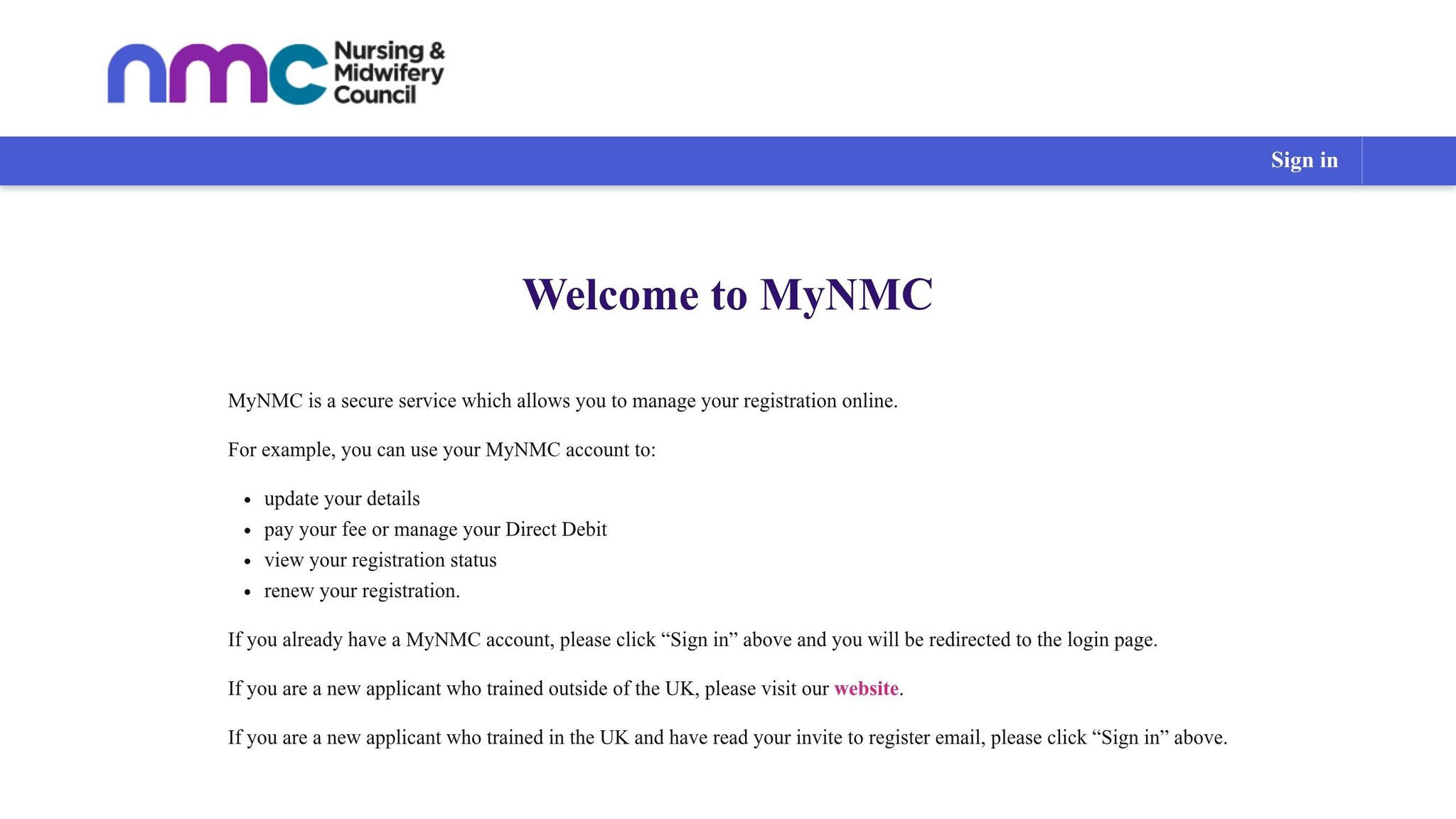
Once your confirmer has signed everything off, the last part is your declaration in MyNMC. Use MyNMC only to submit it. Don’t upload your evidence. Just keep your portfolio safe in case the NMC asks to audit it.
You can submit your application from 60 days before the first day of the month your registration expires. Your exact deadline will appear in MyNMC, so check that rather than guessing.
The online form follows a set order:
| Step | What you do | Details needed |
|---|---|---|
| Confirm requirements | Tick to confirm hours, CPD, feedback and reflections are complete | None |
| Enter discussion partner details | Add your reflective discussion partner's name and contact details | Name and contact details |
| Enter confirmer details | Add your confirmer's name, NMC PIN (if applicable), email and professional address | Use your confirmer's PIN, not yours |
| Make declarations | Confirm your health and character declaration and professional indemnity arrangement | None |
| Pay the annual registration fee | Pay through MyNMC or confirm your Direct Debit is active | Payment details or Direct Debit confirmation |
There are two admin mistakes that catch people out again and again.
- Entering your own NMC PIN in the confirmer field. The system will not let the application go through if you do this [4].
- Missing the fee payment. If the fee is not received, your registration will lapse and you will be removed from the NMC register [3].
If you pay by Direct Debit, the NMC collects the fee automatically, so don’t cancel it or make changes to it around submission time. If you don’t use Direct Debit, you’ll need to pay manually as part of the process.
It’s worth submitting early. That gives you a bit of breathing room if anything needs fixing. You should get a confirmation email within two days, or within five days if you pay by Direct Debit [5].
Record-Keeping, Planning and Final Checklist
Confidentiality and Anonymisation Across All Revalidation Records
Once you’ve logged your evidence, the next job is simple: keep every record anonymous and secure. Remove names, dates of birth, locations, and any other identifying details before you file anything in your portfolio.
Do the same for your reflective discussion and confirmation records. These can include personal data about the other professionals involved, so they also need to be anonymised and stored securely.
A Simple 3-Year Plan to Stay Ready for Revalidation
After confidentiality, timing is the big thing. Spread the work across the full three-year cycle so nothing piles up at the end.
| Year | Focus | Key Actions |
|---|---|---|
| Year 1 | Foundation | Set up a secure portfolio. Log practice hours and file CPD evidence as you complete it. |
| Year 2 | Collection | Keep logging hours and CPD, collect feedback as it happens, and draft reflections while events are fresh. |
| Year 3 | Finalisation | Complete any remaining hours and CPD, finish all five reflections, and arrange discussion and confirmation before your deadline. |
For CPD entries, use our NMC Revalidation: CPD Log Checklist.
The NMC says you should get confirmation in the final year of your three-year renewal period so it is as recent as possible [4].
Conclusion: Key Steps to Complete NMC Revalidation with Confidence
With your records secure and your timetable in place, do one final check against the NMC requirements. Keep your practice hours, CPD, feedback, reflections, discussion, confirmation, and declarations on track across the cycle.
You should also keep your portfolio for at least three years in case the NMC selects your application for verification.
If the reflective accounts are the trickiest part, ReflectionGuide can help you draft all five and check anonymisation. For more guidance, see our NMC Revalidation Reflective Accounts: A Simple Guide.
FAQs
What counts as practice hours for NMC revalidation?
For NMC revalidation, you need to complete 450 practice hours during each three-year registration cycle.
If you’re dual-registered as a nurse and midwife, that goes up to 900 hours. For triple registration, you need 1,350 hours.
The NMC states that these hours must be relevant to your scope of practice. That’s the key point here: it’s not just about clocking up time, but making sure the work fits the role you’re registered to carry out.
Keep clear, accurate records in your professional portfolio. The NMC may ask for evidence as part of the verification process, so it helps to have everything logged properly as you go.
Who can be my confirmer for NMC revalidation?
Ideally, your confirmer should be your line manager. If you don’t have one, choose an NMC-registered nurse, midwife or nursing associate if you can.
If that isn’t possible, another UK-regulated healthcare professional can confirm your revalidation. Family members and close friends can’t act as your confirmer because that creates a conflict of interest. You’ll need to add their contact details and professional identification number in MyNMC.
What happens if I miss my NMC revalidation deadline?
If you miss your NMC revalidation deadline, your registration will expire. It’s your responsibility to plan ahead and send your application on time.
If illness, disability or pregnancy gets in the way, contact the NMC as early as you can. You may be able to ask for support, including a short extension, through your MyNMC account.