NMC Revalidation: CPD Log Checklist
Your CPD log must prove 35 hours (20+ participatory), link entries to the Code, include evidence and protect confidentiality.
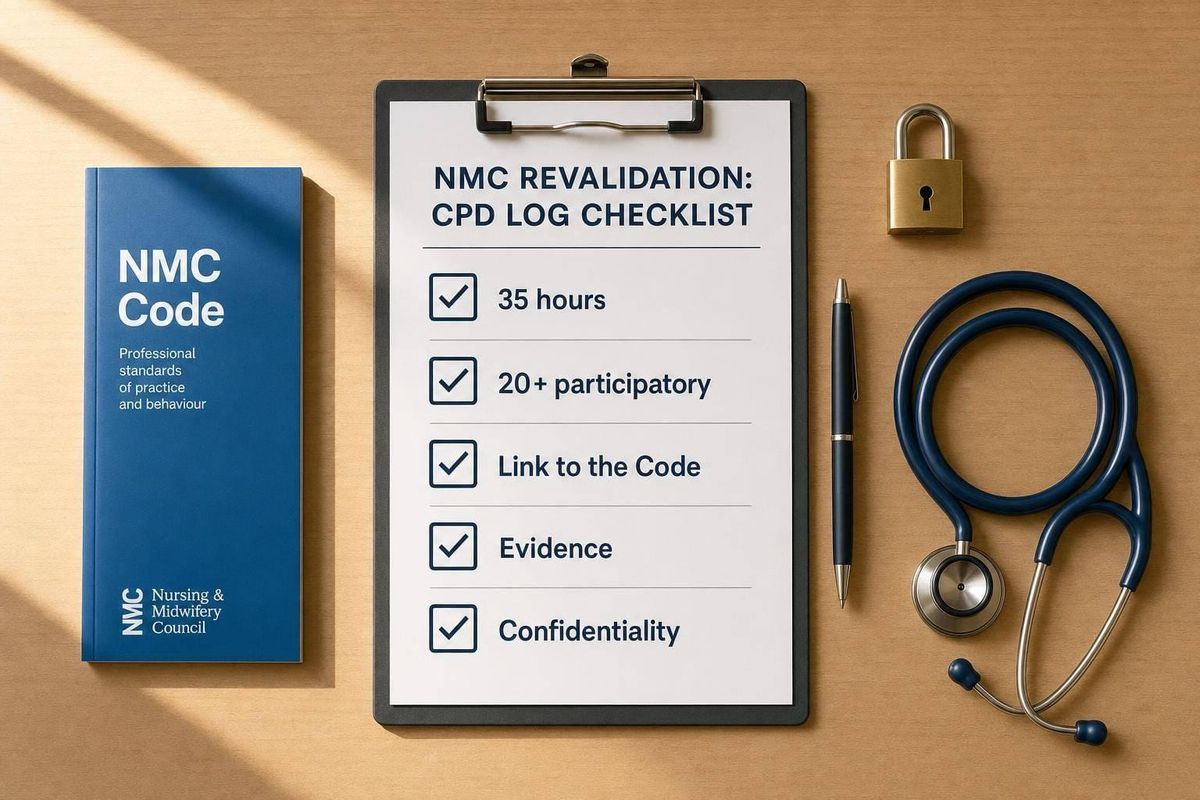
If I want my NMC revalidation to go smoothly, my CPD log needs to prove 35 hours over 3 years, with at least 20 participatory hours, and every entry must link to my current role and the NMC Code.
That is the whole job in one line. If my log is missing dates, hours, Code links, or proof, I can run into delays at confirmation or if I am picked for verification. And if I am selected, I may have only 21 days to send my records.
Here’s the short version I’d use before submission:
- 35 total CPD hours logged across my 3-year period
- 20+ participatory hours recorded clearly
- Each entry includes date, topic, method, total hours, participatory hours, role link, and Code link
- Evidence matches each entry
- No identifiable details about patients, service users, or colleagues
- Totals match what I plan to enter in MyNMC
- Records are stored safely and easy to find
I’d also make sure I do not count solo study as participatory learning. Reading, self-study, and solo e-learning can count as CPD, but not as participatory unless there was interaction with other professionals.
In short: this checklist is about checking hours, checking each entry, matching evidence, protecting confidentiality, and making sure my log fits into the rest of my revalidation portfolio.
Core NMC CPD requirements your log must meet

Required CPD hours and participatory learning
Your CPD log needs to show that your hours are complete and linked to your scope of practice. At least 20 hours must be participatory, which means learning that involves interaction with other professionals [1].
Participatory learning can happen in person or online [1].
All CPD must connect to your current role, whether you work in clinical care, management or education [1].
Use the checklist below to check each log entry against these rules.
What each CPD log entry must include
Each entry needs the minimum details below. If even one field is missing, it can slow down confirmer review or verification.
| Required Field | What to Record |
|---|---|
| CPD Method | How you learned (e.g., workshop, self-study) |
| Topic & Relevance | What you learned and how it links to your current role |
| Date(s) | When the activity took place (e.g., 14 March 2025) |
| Total Hours | Full duration of the activity |
| Participatory Hours | The portion spent interacting with other professionals |
| Link to NMC Code | The specific part of the Code the activity relates to |
| Evidence | Proof of completion such as a certificate, attendance record or provider email |
Those are the core details needed for portfolio review. Linking every entry to the NMC Code is mandatory [1].
Accepted formats, storage and audit readiness
The NMC does not ask for one set format. You can use a paper file, spreadsheet or digital portfolio system, as long as it includes the mandatory fields above [1]. The recommended template can help you spot any gaps before review [1].
For storage, keep digital logs secure and backed up. If you use paper records, scan them and keep a digital copy too. Leave identifiers out of both paper and digital versions, and keep the whole log in a state that is ready for audit throughout the cycle [2].
Once your records are stored properly, the log can slot into your wider revalidation portfolio.
Start Your Guided Reflection Today
Create structured, CPD-ready reflections using recognized models like Gibbs, Driscoll, Kolb, and ERA. Perfect for NMC revalidation, HCPC CPD, and GMC appraisal.
Start Reflecting NowNMC Revalidation CPD Explained | What Counts Towards Your 35 Hours?
NMC revalidation CPD log checklist
Use this checklist to review your totals, entries and evidence before you submit.
Hour totals and revalidation period checks
- ☐ Total CPD = 35 hours, including at least 20 participatory hours [1]
- ☐ Participatory and non-participatory hours are recorded separately for each entry
- ☐ Every activity falls within the current three-year revalidation period [1]
- ☐ All CPD relates to your current scope of practice, whether that is clinical care, management, education or research [1]
Once the totals are right, go through each entry one by one.
Entry-by-entry compliance checks
Check each row in your log and make sure these fields are there and filled in:
- ☐ Date(s) - the exact date the activity took place, not just the month or year
- ☐ Title or topic - a short description of the learning
- ☐ CPD method - how you learned, such as self-directed learning, a workshop, conference, training course or group meeting
- ☐ Total hours - the full length of the activity
- ☐ Participatory hours - the part of those hours that involved interaction with other professionals [1]
- ☐ Relevance to role - a short note on how the activity links to your day-to-day practice
- ☐ Link to the NMC Code - the exact theme of the Code the activity relates to, such as Prioritise People or Practise Effectively
- ☐ Evidence label - a link to the matching proof of completion
Then check that every entry matches supporting evidence and strip out any identifiers.
Evidence, confidentiality and record-keeping checks
- ☐ Each entry has matching evidence
- ☐ Each piece of evidence is cross-referenced to its log entry using a consistent label, such as Evidence 1 or Evidence 2
- ☐ For self-directed activities such as journal reading or self-directed e-learning, you have notes or a written summary of what you learned and the outcomes of that learning
- ☐ Any reflective text is anonymised
- ☐ Keep the log in one accessible place so you can find it fast during verification. If selected for verification, you have 21 days to submit supporting information [2]
If you add short reflective statements, give them a privacy check before saving.
After that, your log is ready for portfolio review.
Using the CPD log within your revalidation portfolio
NMC CPD Log Formats Compared: Paper vs Spreadsheet vs Digital
Once your log is complete, it becomes more than a record of hours. It helps you build your reflective accounts, prepare for your confirmer review, and complete your MyNMC submission.
Linking CPD entries to reflective accounts and the NMC Code
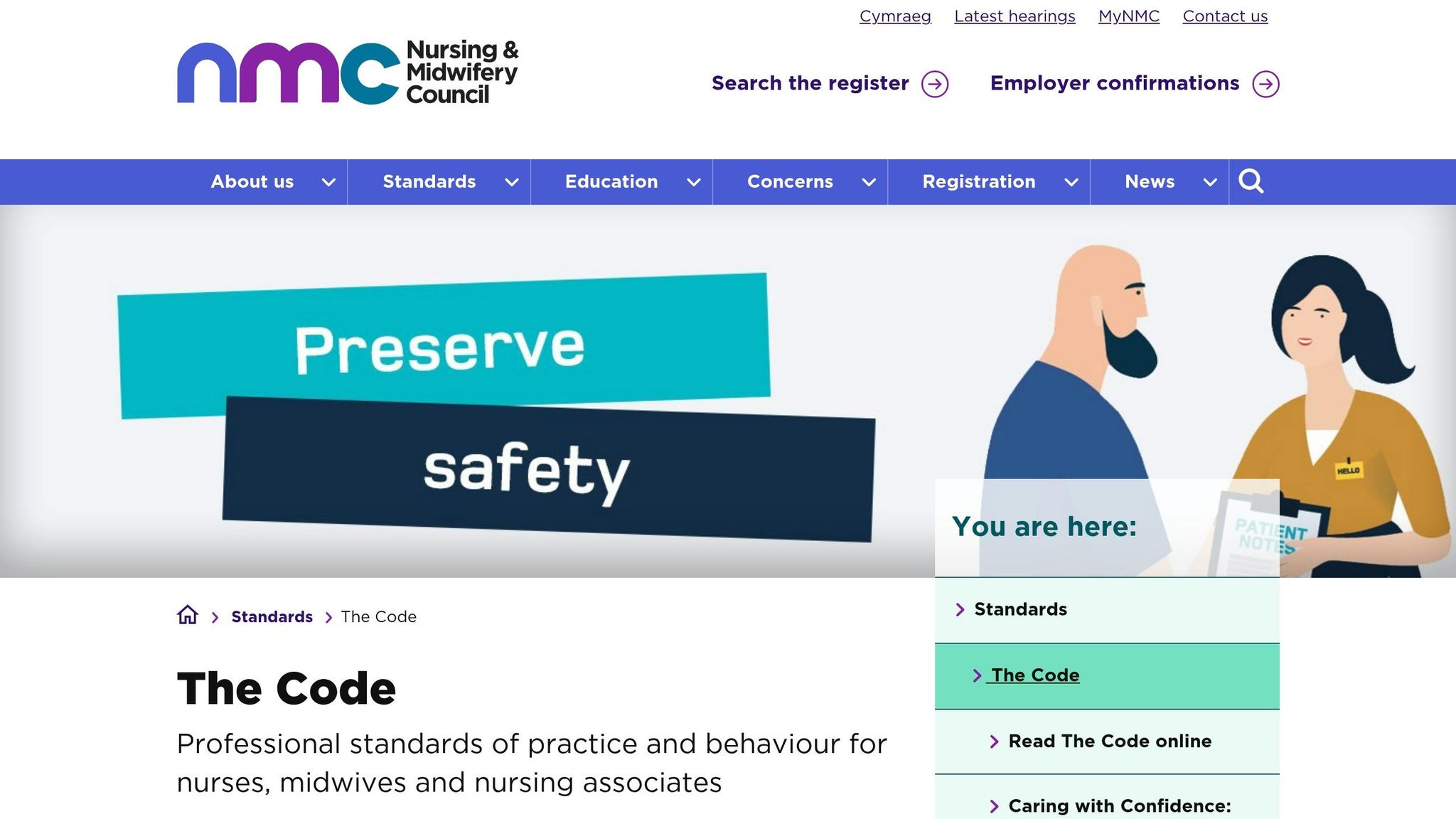
It helps to link each CPD entry to one of the four Code themes: Prioritise people, Practise effectively, Preserve safety, or Promote professionalism and trust. Doing this as you go makes reflection much easier later on.
The NMC requires five written reflective accounts during your three-year cycle, and at least one of these can be based directly on a CPD activity recorded in your log [3]. When you write that account, you need to explain:
- what you learned
- how it changed or improved your practice
- how it links to the Code [3]
If reflective writing feels hard, Reflection Guide can help you draft structured reflections using Gibbs or Driscoll, with privacy checks built in.
Preparing for reflective discussion and confirmer review
Your reflective discussion must take place in a face-to-face meeting or video call with another NMC-registered nurse or midwife. The discussion should cover your written reflections and how they link to the Code [1][3]. They then sign the form to confirm that all five accounts were discussed [3].
Before your confirmation meeting, check that the dates, total hours, and Code themes in your CPD log match your reflective accounts . Confirmers will check that each reflective account points to a specific section of the Code and that your CPD dates sit within the three-year revalidation period .
Keeping everything together in one portfolio makes it simpler to share evidence with your confirmer and, if needed, during an audit . When your log and reflections line up properly, the confirmer check is usually much faster.
Choosing a log format: paper, spreadsheet or digital tool
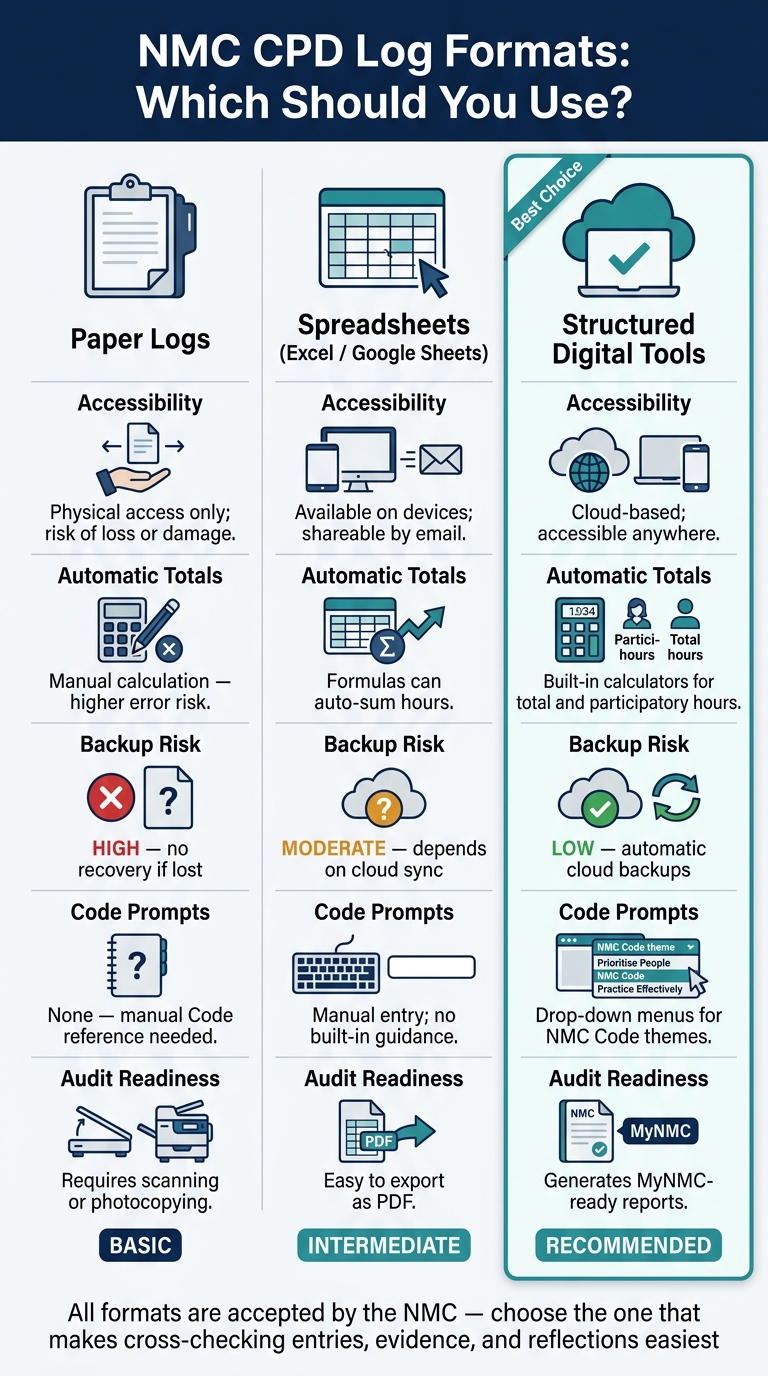
Choose the format that lets you match entries, evidence, and reflections with the least friction.
| Feature | Paper Logs | Spreadsheets (Excel/Sheets) | Structured Digital Tools |
|---|---|---|---|
| Accessibility | Physical access only; risk of loss or damage | Available on devices; easy to share by email | Cloud-based; available anywhere with internet |
| Automatic Totals | Manual calculation; higher risk of error | Can use formulas for automatic hour sums | Built-in calculators for total and participatory hours |
| Backup Risk | High - no recovery if lost or destroyed | Moderate - depends on saving or cloud syncing | Low - usually includes automatic cloud backups |
| Code Prompts | None; needs manual reference to the Code | Manual entry; no built-in guidance | Often includes drop-down menus for Code themes |
| Audit Readiness | Needs scanning or photocopying for submission | Easy to convert to PDF for upload | Often generates reports suited to MyNMC |
Pick the format that makes totals, evidence, and reflections easiest to cross-check. Digital and online portfolios are often the simplest option for security, storage, and uploading at the final application stage . That said, a well-kept spreadsheet can work just as well if you update it regularly and store scanned evidence in a secure folder.
Common CPD log mistakes and final checks
Incomplete data and mismatched totals
Missing information can cause problems at revalidation. Even small gaps in your log can slow down review [1].
It’s also worth checking your totals carefully. If the total in your log doesn’t match what appears in MyNMC, that can lead to extra scrutiny. And make sure every activity sits inside your own three-year revalidation window. CPD done outside that period cannot be counted .
Misclassified CPD and confidentiality risks
Two checks catch most problems: using the right learning type and keeping records anonymised.
Don’t count solo reading or self-study as participatory learning. Participatory hours need actual interaction with at least one other professional [1]. If those hours are counted the wrong way, your participatory total is inflated and your log becomes non-compliant.
Confidentiality is the other main risk. Logs and reflective notes must not include any detail that could identify a patient, service user, or colleague . Stick to anonymised notes only. That means no names, no ward locations, and no identifiable dates.
Final pre-submission checklist
Use this final scan to catch the errors most likely to delay confirmation.
| Checklist Item | What to Confirm |
|---|---|
| Total hours | At least 35 hours logged, including at least 20 participatory hours [1] |
| Entries, Code links and evidence all match | Every entry includes method, topic, dates, hours, relevance, a specific Code link, and supporting evidence [1] |
| Anonymisation | No identifiable patient, service user, or colleague details are present |
| MyNMC match | Log totals match exactly what you plan to enter into the portal |
| Backup | Portfolio is stored securely and can be produced if requested during an audit |
Update the log after each activity. It’s one of the simplest ways to avoid gaps, missing evidence, and last-minute stress .
FAQs
What counts as participatory CPD?
Participatory CPD is any learning activity where you actively engage with one or more other professionals. That interaction can happen face to face or online, so everyone doesn’t need to be in the same room.
This can include conferences, workshops, training courses, group meetings outside day-to-day practice, and clinical supervision.
What evidence should I keep for each CPD entry?
For each CPD entry, keep a clear log of your 35 hours of CPD.
Your record should show:
- the method
- the topic
- how it relates to your practice
- the dates
- the total hours and participatory hours
- the relevant section of the Code
You should also keep physical or digital proof that you completed each activity. That might include attendance certificates, study day programmes, event registers, meeting minutes, or emails from the provider.
What happens if my CPD log is checked?
If your CPD log is checked, your confirmer will do a plausibility check to make sure it meets the minimum requirements: 35 hours in total, including 20 hours of participatory learning.
They’ll look at whether your activities match your scope of practice, sit within your three-year cycle, and are backed up by evidence. If anything doesn’t look right, they’ll talk it through with you and may ask for more evidence or for some entries to be rewritten.