NMC Revalidation Reflective Accounts: A Simple Guide
Practical steps to prepare five NMC reflective accounts, link each to the Code, preserve confidentiality and record your discussion.

NMC revalidation is mandatory for nurses, midwives, and nursing associates every three years to maintain their registration. Reflective accounts are a core part of this process. You need to write five reflective accounts using the official NMC form, linking your learning to the NMC Code. These accounts can be based on CPD activities, feedback, or professional experiences.
Key points to remember:
- Use the official NMC form for compliance.
- Keep reflections tied to the four NMC Code themes: prioritising people, practising effectively, preserving safety, and promoting professionalism and trust.
- Maintain confidentiality - avoid using identifiable information about patients or colleagues.
- Store completed forms securely for potential verification.
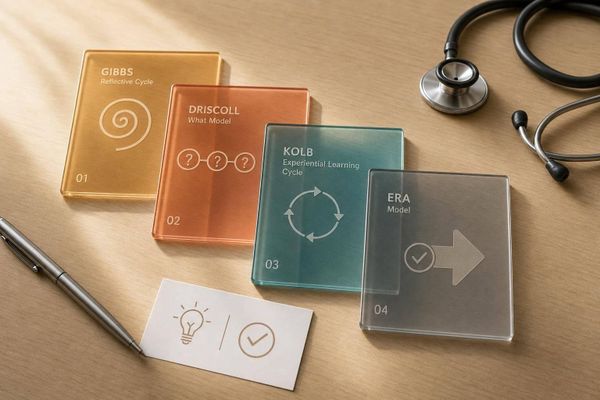
- Use models like Gibbs' Reflective Cycle or Driscoll's Model to structure your reflections.
Your reflective discussion must be with an NMC-registered professional and documented using the NMC Reflective Discussion Form. Regular reflection throughout the three-year cycle is recommended to avoid last-minute stress.
This guide simplifies the process, ensuring you meet NMC requirements while improving your professional practice.
Writing reflective accounts for NMC Revalidation
Start Your Guided Reflection Today
Create structured, CPD-ready reflections using recognized models like Gibbs, Driscoll, Kolb, and ERA. Perfect for NMC revalidation, HCPC CPD, and GMC appraisal.
Start Reflecting NowNMC Requirements for Reflective Accounts
Reflective accounts play a key role in meeting the NMC's requirements. This section explains what is expected and how to align your practice with these guidelines. Following these rules not only ensures compliance but also strengthens the value of your reflections.
Core Rules for Reflective Accounts
The NMC specifies:
"You must have prepared five written reflective accounts in the three year period since your registration was last renewed or you joined the register." [1]
It's essential to use the official NMC form for each account. Using other templates could lead to non-compliance, especially if your revalidation is selected for verification.
Your reflections should draw from CPD activities, feedback from practice, or notable professional experiences. Each account needs to describe what you learned, how it improved your practice, and its connection to the NMC Code. These don't have to be long or written in an academic style - clear, straightforward notes are sufficient.
Linking Reflections to the NMC Code
Every reflective account must be tied to the NMC Code. This isn't just about meeting a requirement; it's about showing how you apply professional standards in your daily work. [2]
The NMC Code is organised into four themes, and your reflections should connect to at least one of them:
| NMC Code Theme | How to Apply It in Your Reflection |
|---|---|
| Prioritise people | Reflect on feedback from patients or service users and how it influenced your care. |
| Practise effectively | Consider CPD activities and any resulting changes in your approach. |
| Preserve safety | Discuss practice gaps identified through feedback or training and how you addressed them. |
| Promote professionalism and trust | Reflect on how you take responsibility for your development or support colleagues. |
When writing, don't just name the theme - explain how your experiences align with it. For instance, instead of vaguely stating, "This relates to 'Preserve safety'", provide specifics: "This experience relates to 'Preserve safety' as it led me to update my knowledge of infection control procedures." [3]
The next section will outline the rules around confidentiality and form submission, which are crucial for secure and compliant reflections.
Confidentiality and Anonymity Rules
The NMC clearly states:
"Be careful not to record any information which may identify another person." [1]
This means avoiding any details that could reveal the identity of patients, service users, or colleagues. Remove names, dates, locations, and any rare clinical details that might indirectly identify someone. The same principle applies during reflective discussions - ensure no individual can be identified by your discussion partner. [4]
You can store completed forms in paper or electronic formats, but they must be kept securely. These may be requested during the verification process. [1][4]
How to Structure Your Reflective Account
Once confidentiality is ensured, use the NMC form to document your reflection.
Choosing the Right Experience to Reflect On
Your reflection should focus on one of three areas: a CPD activity, practice-related feedback, or a professional event or experience [1]. Each option is valid, and you can even combine them in a single account if relevant.
| Category | Examples |
|---|---|
| CPD Activity | Attending a training session, completing an e-learning course, reading a clinical journal |
| Practice-related Feedback | Feedback from patients, observations from colleagues, or comments during an appraisal |
| Professional Event | Handling a challenging clinical situation, participating in a team meeting, or adapting to new workplace protocols |
When reflecting, consider: What changes to your practice did this experience inspire?
Filling In the NMC Reflective Accounts Form
The NMC form is structured around four key questions:
- The Experience - Provide a clear description of the CPD activity, feedback, or event you are reflecting on.
- Learning - Summarise what you learned from the experience.
- Improvement - Explain how your practice has changed or improved as a result.
- The Code - Identify which part of the NMC Code relates to your reflection and explain how.
"Each reflective account must be recorded on the approved form and must refer to: an instance of your CPD, and/or a piece of practice-related feedback you have received, and/or an event or experience in your own professional practice and how they relate to the Code." - The Nursing and Midwifery Council [1]
While there’s no strict word limit, professional advice often suggests aiming for about 800 words in total across all four sections [5]. Keep your writing straightforward, focusing on describing the experience, what you learned, and how it influenced your practice.
Once you’ve completed your form, review it carefully to ensure it’s comprehensive.
Checking for Accuracy and Anonymity
After filling out the form, do a final check for accuracy and ensure anonymity is maintained throughout. Confirm that your reflection addresses all four sections and that the connection to the NMC Code is clear and specific [1].
Once you’re confident in your account, store the completed form securely, either digitally or on paper, as part of your professional portfolio [1]. This document may be needed during the verification process, so keeping it easily accessible is essential.
Using Reflective Models to Write Your Account
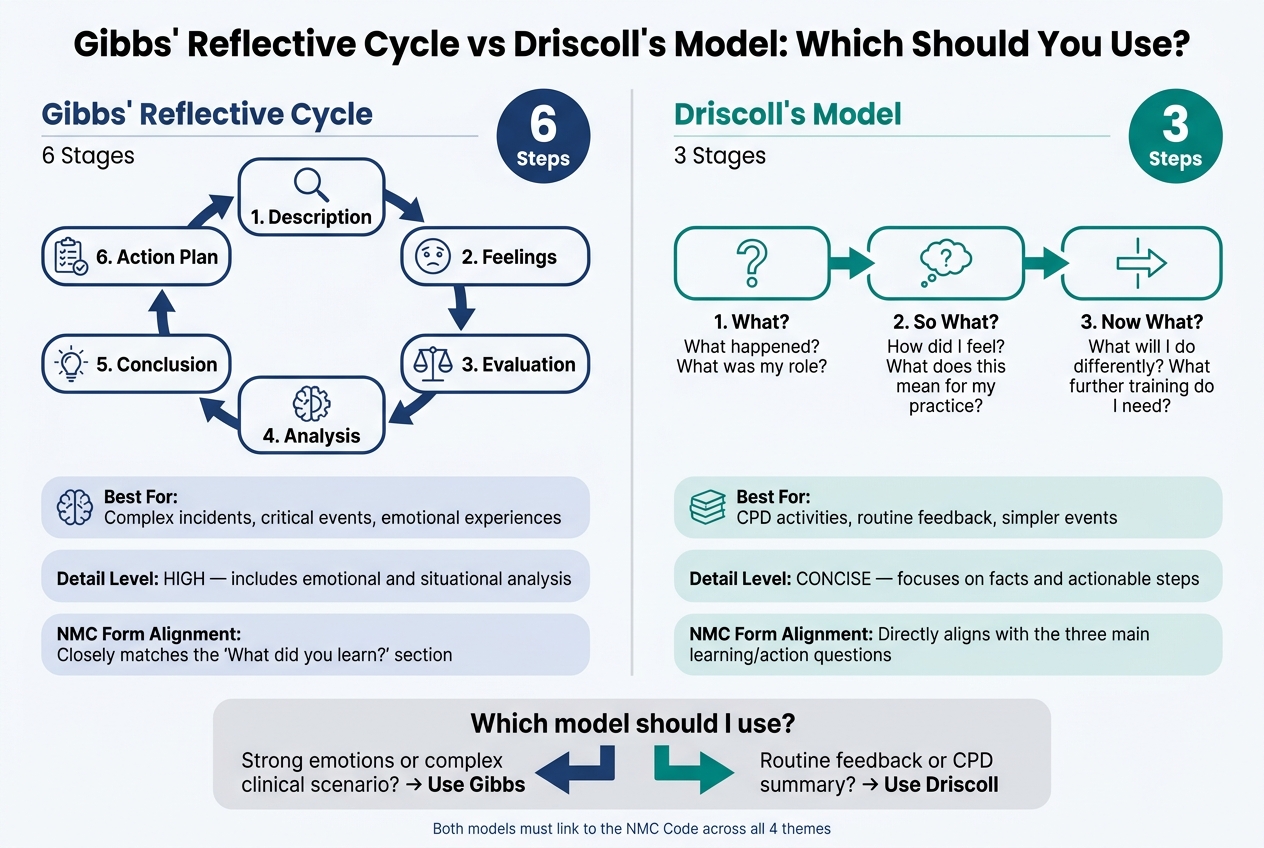
Gibbs' Reflective Cycle vs Driscoll's Model: Which Should You Use?
Once you’ve structured your reflective account, a reflective model can help you dive deeper into your analysis. While the NMC doesn’t mandate a specific model, using one provides a clear framework, making it easier to create a thoughtful, analytical account that ties directly to the NMC Code.
Gibbs' Reflective Cycle
Gibbs' Reflective Cycle is widely recognised in nursing and midwifery for its thorough, step-by-step approach. It consists of six stages: Description, Feelings, Evaluation, Analysis, Conclusion, and Action Plan. This structure is ideal for exploring experiences in greater depth.
Each stage aligns neatly with the NMC form. For example:
- Description relates to what happened.
- Feelings, Evaluation, and Analysis focus on what you learned.
- Conclusion and Action Plan outline how your practice has improved.
This model is particularly helpful for emotionally intense or complex situations, like managing a difficult conversation with a family or responding to a clinical incident requiring quick decision-making. The "Feelings" stage is especially valuable, as it helps you process the emotional aspects of the experience, often leading to deeper insights [6].
When you reach the Action Plan stage, aim to be specific. Instead of writing something broad like "I will work on my communication skills", outline a concrete plan, such as attending a communication workshop or arranging a debrief with your manager within a set time frame .
For less complicated scenarios, a simpler model may be more appropriate.
Driscoll's What? So What? Now What? Model
Driscoll's model, inspired by Borton's framework, is a streamlined option. It works well for CPD activities or routine feedback where a detailed six-step reflection might feel excessive [7].
| Stage | Core Question | NMC Form Application |
|---|---|---|
| What? | What happened? What was my role? | Describe the CPD activity, feedback, or practice event |
| So What? | How did I feel? What does this mean for my practice? | Link the experience to the NMC Code and professional growth |
| Now What? | What will I do differently? What further training do I need? | Set a concrete action plan to improve future patient care |
One potential drawback of Driscoll’s model is that it might lead to surface-level reflections [7]. To counter this, ask yourself probing questions during the So What? stage, such as "What does this reveal about my current skillset?" or "How does this align with the NMC Code’s focus on effective practice?" .
Gibbs vs Driscoll: A Side-by-Side Comparison
Deciding between the two models depends on the complexity of the situation and the depth of reflection required [6]. Here’s a quick comparison:
| Feature | Gibbs' Reflective Cycle | Driscoll's Model |
|---|---|---|
| Stages | 6: Description, Feelings, Evaluation, Analysis, Conclusion, Action Plan | 3: What?, So What?, Now What? |
| Level of Detail | High; includes emotional and situational analysis | Concise; focuses on facts and actionable steps |
| Best For | Complex incidents, critical events, or emotional experiences | CPD activities, routine feedback, or simpler events |
| NMC Form Alignment | Closely matches the "What did you learn?" section | Directly aligns with the three main learning/action questions |
As a general rule: if the situation involves strong emotions or a challenging clinical scenario, Gibbs is your go-to. For straightforward reflections, like discussing feedback or summarising a webinar, Driscoll’s model provides a quicker, more focused structure [6][8].
Preparing for Your Reflective Discussion
Your reflective discussion is where your written accounts come to life – a formal conversation that showcases your learning and growth.
NMC Reflective Discussion Requirements
To fulfil the Nursing and Midwifery Council (NMC) requirements, your reflective discussion must be conducted with another NMC-registered professional, such as a nurse, midwife, or nursing associate [4]. During this session, you’ll review all five of your reflective accounts, focusing on what you’ve learned and how your practice has evolved .
The official NMC Reflective Discussion Form must be used to document the session – this is non-negotiable. The form includes details such as your discussion partner’s name, NMC Pin, email, professional address, postcode, and the meeting date. While the form isn’t submitted to the NMC, it must be stored in your portfolio. Be meticulous when entering your partner’s Pin into your MyNMC application [4].
"Many people on our register have told us the reflective discussion is one of the most rewarding elements of revalidation." - The Nursing and Midwifery Council [4]
If your confirmer is also NMC-registered, the reflective discussion can be combined with your confirmation meeting. If not, the reflective discussion must take place first [4]. While in-person meetings are ideal, video calls are equally acceptable [3].
| Requirement | Detail |
|---|---|
| Discussion Partner | Must be an NMC‐registered nurse, midwife, or nursing associate |
| Accounts to Cover | All five written reflective accounts |
| Required Form | Official NMC Reflective Discussion Form (mandatory) |
| Anonymity | No identifiable information about patients or colleagues |
| Storage | Signed form kept in your portfolio (paper or electronic) |
Once your reflective accounts are ready, ensure your portfolio is organised for a seamless discussion.
Organising Your Reflective Portfolio
Before your meeting, make sure all five accounts are completed using the official NMC reflective accounts form. Each of the four Code themes should be referenced at least once across your accounts . During the discussion, be prepared to explain how each account aligns with a specific theme. This demonstrates active engagement with the Code, rather than simply ticking a box.
Keep any supporting materials – such as CPD certificates or feedback notes – alongside relevant reflective accounts. This helps provide context for your discussion partner. Don’t forget to follow confidentiality rules when preparing your portfolio [4].
If you don’t work with other NMC registrants, consider reaching out to professional networks or specialist groups to find a suitable discussion partner [3].
Making Reflection a Regular Habit
Reflection isn’t just about preparing for revalidation – it’s a tool for continuous growth. Building a habit of regular reflection not only keeps your portfolio up to date but also strengthens your ability to engage meaningfully in the reflective discussion.
One common mistake is leaving all five reflections until the final months of the three-year cycle. Spacing them out allows for more thoughtful, accurate accounts and prevents last-minute stress.
"The sooner you reflect on your activity, the more truthful to the event your recollection will be, so make it part of your regular routine." - Royal College of Nursing [9]
Set a monthly reminder to review your portfolio and note any significant experiences [9]. Voice notes immediately after an event can make it easier to capture details for later transcription [9]. Keeping a copy of the NMC Code handy – whether on your desk or saved on your phone – can help you link experiences to professional standards as they happen [9].
Tools like Reflection Guide can support this process, offering a structured way to log reflections digitally throughout your revalidation cycle. This ensures your portfolio is always ready for discussion.
Conclusion
Throughout your revalidation cycle, each reflective account plays a vital role in supporting your professional development and meeting NMC standards. By crafting clear and structured reflections, you not only showcase your growth but also transform everyday experiences into valuable lessons that directly influence patient care across your three-year registration period.
As the Nursing and Midwifery Council explains:
"We want to encourage nurses, midwives and nursing associates to reflect on their practice, so they can identify any improvements or changes to their practice as a result of what they have learnt." [1]
This statement highlights how reflective accounts contribute to improving your practice.
To make the process manageable, keep things straightforward and consistent. Use the official NMC reflective accounts form, align each reflection with the four themes of the Code, and ensure confidentiality for all individuals involved. If you're unsure where to begin, tools like Gibbs' Cycle or Driscoll's framework can provide structure and help guide your thoughts without requiring overly academic writing.
Staying consistent is crucial. Avoid leaving reflections to the last minute - regularly documenting your experiences ensures honest, timely entries and keeps your portfolio discussion-ready.
For added support, Reflection Guide offers a convenient digital platform to log and organise your reflections throughout your revalidation cycle, helping you stay on track and prepared.
FAQs
What should I do if I cannot find an NMC-registered professional for my reflective discussion?
If you’re unable to find an NMC-registered professional for your reflective discussion, you can have it with another NMC registrant. They’ll need to fill out and sign the approved form, including their details. If this isn’t possible, check the NMC guidance for alternative options.
How can I show real impact on my practice if my reflection is based on routine CPD or simple feedback?
To demonstrate the real effects of routine CPD or feedback, focus on how these experiences directly improved your practice. Share what you learned, how it shaped your approach, and the specific adjustments you implemented - whether it was adopting better techniques or refining procedures. Highlight measurable outcomes, such as improved patient care, enhanced skills, or boosted confidence, to show a clear progression from reflection to practical action.
What evidence should I keep with my reflective accounts in case I’m selected for verification?
You should keep evidence like CPD activities, feedback related to your practice, and significant events or experiences from your professional work that tie into your reflective accounts. This will ensure you're ready if chosen for verification. Having these records well-organised and easy to access will make it simpler to show how your reflections meet the NMC's standards.