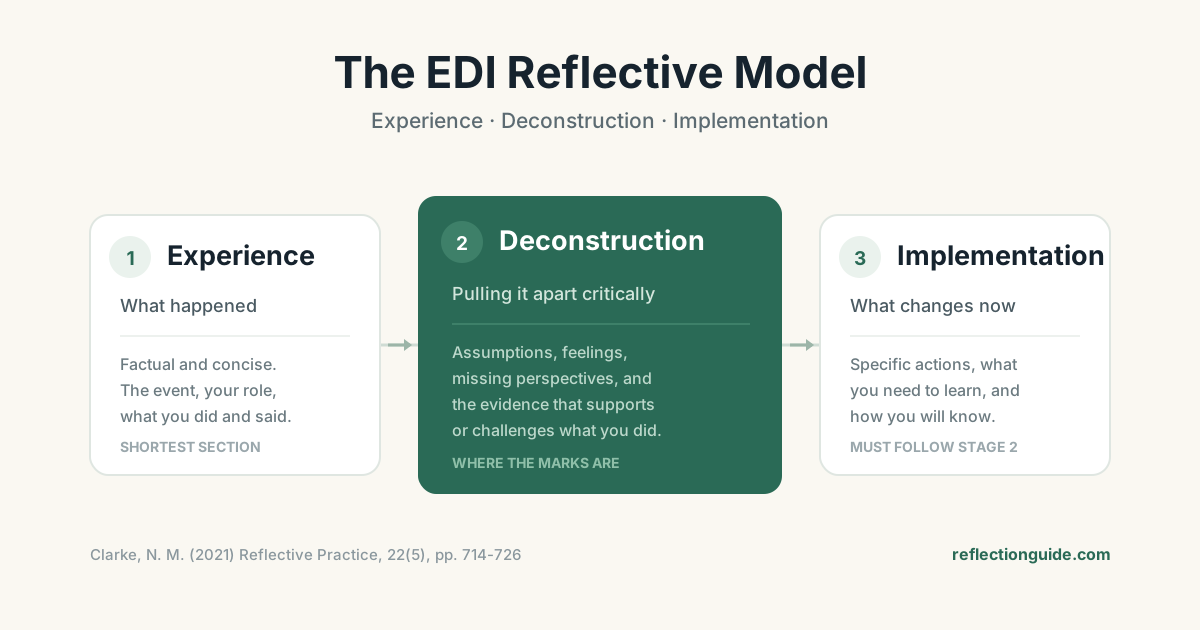
Reflective Practice Is Not Self-Criticism: How to Reflect Positively and Effectively
Use structured reflection (Gibbs, Kolb) to learn, set SMART actions, protect patient confidentiality and avoid rumination.

Reflective practice is about learning, not blaming yourself. It’s a structured way to review experiences, identify what worked, and improve for the future. Unlike self-criticism, which focuses on mistakes and leads to negativity, reflection is forward-thinking and helps build resilience, emotional intelligence, and better patient care.
Key points:
- Self-criticism traps you in a loop of blame and reduces confidence.
- Reflective practice uses structured models (e.g., Gibbs, Kolb) to focus on learning and planning actionable steps.
- Reflection should balance recognising strengths and addressing gaps without harsh judgement.
- Maintaining confidentiality is crucial - anonymise patient details to comply with GDPR.
- Turn insights into clear goals, link them to professional development, and avoid repeating past challenges.
The goal? Use reflection to grow, improve, and feel confident in your abilities while staying professional and compliant.
Reflective Practice vs Self-Criticism: What Is the Difference?
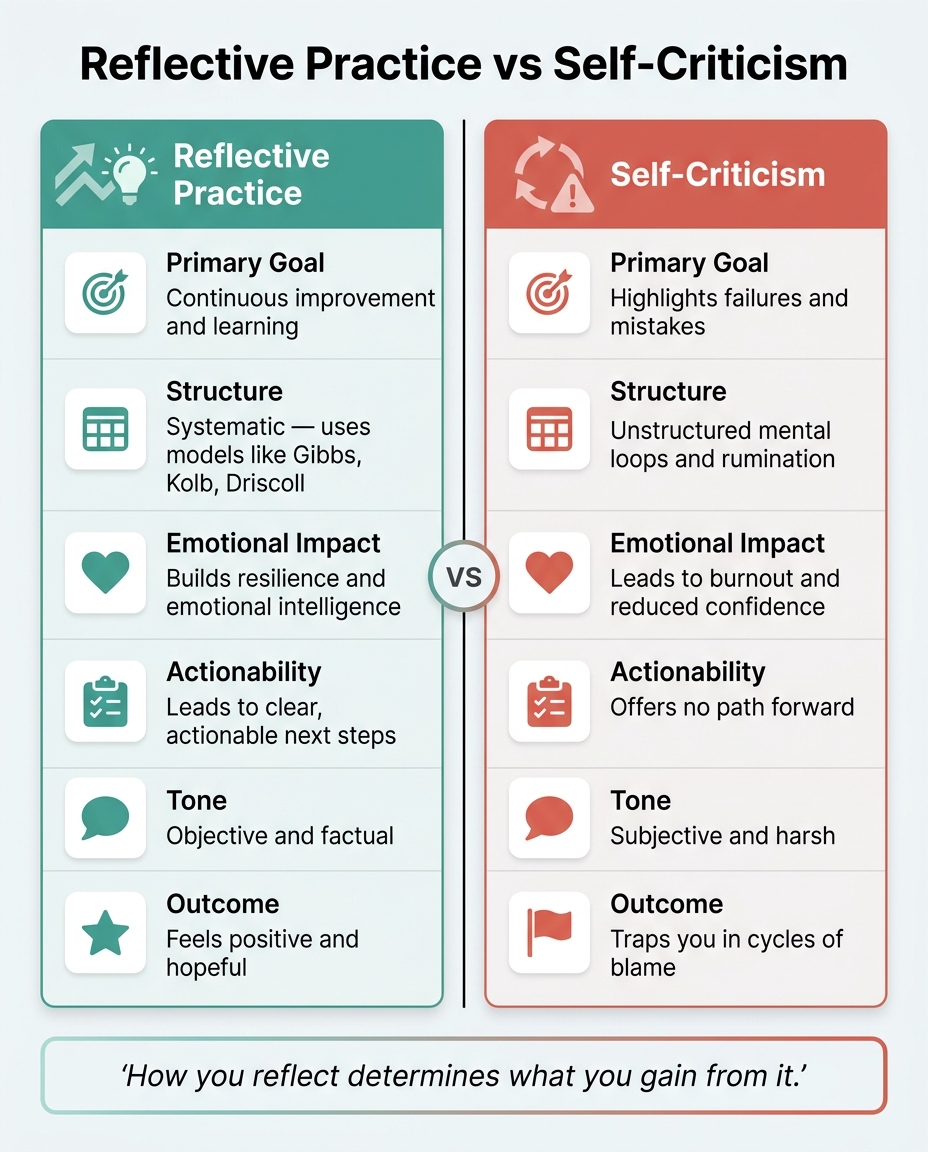
Reflective Practice vs Self-Criticism: Key Differences at a Glance
At first glance, reflection and self-criticism might seem like two sides of the same coin - they both involve looking back on past actions. But their approaches and outcomes couldn’t be more different.
What Reflective Practice Is For
Reflective practice takes an objective approach to reviewing experiences, aiming to evaluate outcomes and identify areas for improvement . It’s not about letting your thoughts wander aimlessly but about following a structured process: understanding what happened, learning from it, and planning what to do differently next time. This forward-thinking aspect is what makes it so effective.
When done properly, reflection sharpens decision-making, helps you recognise patterns in your work, and directly improves patient care outcomes [1]. Beyond that, it supports mental wellbeing by providing a constructive way to process the emotional challenges of working in healthcare [1][2]. Self-criticism, on the other hand, doesn’t offer the same benefits.
Why Self-Criticism Gets in the Way
Self-criticism tends to focus on mistakes, often fixating on them in a way that undermines your abilities without offering any solutions . Instead of leading to growth, it creates a loop - replaying the same errors repeatedly without resolution. This mental cycle, often referred to as rumination, is a major obstacle to learning.
Reflection can acknowledge where we got it wrong, but it also illuminates a way out of challenges and setbacks — and avoids the harsh self-judgement too.
Excessive self-blame doesn’t just damage morale - it can also stall professional growth. It erodes confidence, heightens the risk of burnout, and leaves you less prepared to handle similar situations in the future [2]. The Health and Care Professions Council (HCPC) highlights the importance of focusing on what you can control:
"Reflection should focus on what is in your control, rather than replaying past mistakes. It should leave you feeling positive and hopeful, rather than negative about your own abilities." [2]
Here’s a quick comparison of the two approaches:
| Feature | Reflective Practice | Self-Criticism |
|---|---|---|
| Primary goal | Continuous improvement and learning [2] | Highlighting failures and mistakes |
| Structure | Systematic, using models like Gibbs or Driscoll | Unstructured mental loops or rumination |
| Emotional impact | Builds resilience and emotional intelligence [1] | Leads to burnout and reduced confidence [2] |
| Actionability | Leads to actionable steps | Offers no path forward |
| Tone | Objective and factual [1] | Subjective and harsh |
The key takeaway? How you reflect determines what you gain from it. Proper reflection is honest but not punishing. It acknowledges challenges while keeping the focus on solutions and the future [2].
Start Your Guided Reflection Today
Create structured, CPD-ready reflections using recognized models like Gibbs, Driscoll, Kolb, and ERA. Perfect for NMC revalidation, HCPC CPD, and GMC appraisal.
Start Reflecting NowHow Structured Reflective Models Keep You on Track
Without a clear framework, reflection can easily spiral into unproductive storytelling or endless overthinking. Structured models provide a clear path for reflection, giving it a beginning, a middle, and an end with purpose.
Overview of Key Reflective Models
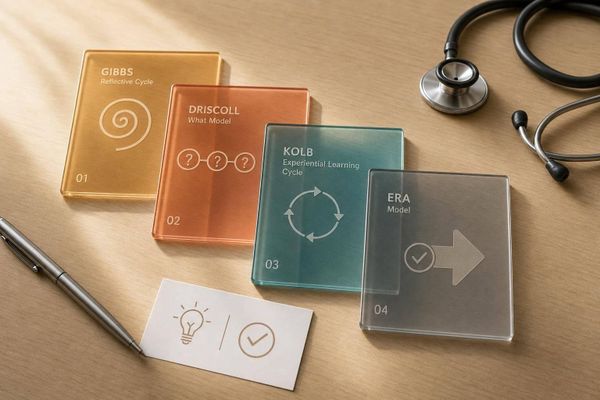
In healthcare, three reflective models are commonly used: Gibbs' Reflective Cycle, Kolb's Learning Cycle, and the "What? So What? Now What?" framework, often linked to Driscoll and Rolfe.
- Gibbs' Reflective Cycle breaks reflection into six stages: Description, Feelings, Evaluation, Analysis, Conclusion, and Action Plan . This approach helps separate emotions from analysis, making it easier to objectively evaluate and learn from experiences.
- Kolb's Learning Cycle includes four stages: Concrete Experience, Reflective Observation, Abstract Conceptualisation, and Active Experimentation . It’s designed to connect specific experiences to long-term professional development, treating each situation as an opportunity to grow.
- "What? So What? Now What?" simplifies reflection into three steps: stating the facts, understanding their relevance to your work, and deciding on a plan of action . Its straightforward structure helps you quickly turn reflection into practical steps.
These frameworks not only organise your thoughts but also make reflection a more productive and meaningful process.
How Reflective Models Keep Reflection Constructive
The strength of a structured model lies in its ability to prevent reflection from becoming a mere checklist or an emotional outpouring. By clearly dividing description from analysis, these models encourage you to focus on what matters: understanding the situation's significance and planning for the future.
As noted by Revalidation Copilot:
"Structured reflection is not about proving you can follow a template. It's about showing the NMC - and yourself - that you can learn from what you do every shift."
– Revalidation Copilot
Keeping descriptions concise (just 2–3 sentences) allows you to zero in on actionable insights.
Comparison of Reflective Models
Here’s a quick comparison of the three models to help you decide which one fits your needs:
| Reflective Model | Structure | Best Use Case | Prevents Self-Criticism |
|---|---|---|---|
| Gibbs' Reflective Cycle | 6 stages: Description, Feelings, Evaluation, Analysis, Conclusion, Action Plan | Complex incidents and ethical dilemmas | Separates emotional responses from objective analysis |
| Kolb's Learning Cycle | 4 stages: Concrete Experience, Reflective Observation, Abstract Conceptualisation, Active Experimentation | Linking experiences to long-term CPD planning | Frames each experience as a learning opportunity |
| "What? So What? Now What?" | 3 stages: What (Facts), So What (Learning), Now What (Action) | Routine CPD and quick debriefs | Moves swiftly from facts to action, limiting dwelling on mistakes |
The model you choose should align with the situation. For emotionally charged or significant events, Gibbs' Reflective Cycle is ideal. For quick debriefs after routine tasks, "What? So What? Now What?" works well. And for integrating experiences into broader professional growth, Kolb's Learning Cycle is the go-to.
Tools like Reflection Guide can help you navigate these models, ensuring your reflections stay focused, professional, and geared towards improvement.
How to Balance Strengths, Challenges, and Learning Points
Effective reflection is about finding the right balance between recognising successes and identifying areas for growth. This approach ensures your reflections are both constructive and meaningful.
Recognising and Building on Your Strengths
Acknowledging what went well – and understanding why – helps transform isolated successes into consistent strengths [3]. The Evaluation stage from Gibbs' Reflective Cycle is particularly useful here. Consider asking yourself: "What went well, and how did I contribute to that outcome?" . For instance, you might recognise that you stayed calm under pressure, communicated effectively, or spotted a clinical issue early. Don’t just stop at identifying the success; delve into the why. Was it your communication style, teamwork, or the environment that played a role?
By connecting your strengths to professional standards like the NMC Code or HCPC standards, you demonstrate how your actions align with regulatory expectations [3]. This not only reinforces your professional practice but also provides a framework for replicating positive outcomes.
"Reflection isn't about being self-critical. It's about being honest, open, and proactive in your learning." – ReflectRN
Identifying Gaps Without Self-Blame
Recognising areas for improvement doesn’t mean being overly critical of yourself. Reflection should focus on actionable changes rather than dwelling on mistakes. When reflecting on what didn’t go as planned, aim for a specific and constructive approach. Instead of saying, "I handled that badly," consider reframing it: "Next time, I would move the conversation to a private space earlier to minimise distress." This approach turns a perceived gap into a clear, actionable learning point .
Linking these gaps to professional standards or evidence-based guidelines can help you view them as opportunities for growth rather than personal shortcomings. For example, aligning your reflection with a specific guideline can shift the focus to professional development, making the process more objective and less about self-criticism [3].
Keeping a Professional and Factual Tone
The tone of your reflection is crucial, especially if it’s being submitted for revalidation or appraisal. Stick to factual descriptions of events – the who, what, where, and when – and save your emotional responses for a separate section. This separation ensures your account remains clear and objective .
Avoid using overly self-critical language, as it can undermine the professionalism of your reflection. Instead, opt for neutral phrasing like, "On reflection, an earlier intervention may have been more effective." As the HCPC advises:
"Reflection requires honesty and self-critical assessment, but it shouldn't be a punitive exercise." – HCPC [2]
Maintaining a factual and balanced tone not only makes revalidation submissions smoother but also fosters a mindset geared towards learning and improvement. Tools like Reflection Guide, with its privacy checks and guided prompts, can help you stay on track, ensuring your reflections meet professional standards for revalidation and appraisal.
Turning Reflection into an Action Plan
Reflection only becomes meaningful when it leads to clear, actionable steps. Without a plan, even the most honest reflection remains just an intellectual exercise. The aim is to shift from reflection-on-action – analysing past events – to reflection-for-action – determining how to approach things differently in the future [4]. This transition turns reflective insights into practical improvements, aligning well with the broader goal of refining professional practices.
Setting Specific and Measurable Goals
Vague intentions rarely lead to meaningful change. Instead of saying, "I need to communicate better", aim for something more concrete, like: "When a patient seems distressed, I will acknowledge their emotions by saying, 'I can see this is really difficult for you,' before delivering clinical information." This level of detail makes the goal not only actionable but also easier to evaluate.
Using the SMART framework (Specific, Measurable, Achievable, Relevant, Time-bound) helps to turn reflective insights into clear objectives. For instance, you might set a goal to complete an online resuscitation refresher course by a specific date . Adding a review point – say, three months later – ensures accountability .
Once these goals are clearly defined, the next step is to incorporate them into your CPD planning.
Linking Reflection to Your CPD Planning
Reflection and CPD planning should work hand in hand, not as isolated tasks. If your reflection uncovers a knowledge gap or skill deficiency, this should feed directly into your Personal Development Plan (PDP) rather than being forgotten or sidelined.
"Your personal development plan should drive your activities, not be an afterthought." – Dr. Sarah Mitchell, Senior NHS Appraiser
For NMC revalidation, nurses and midwives are required to record five written reflections over the three-year revalidation period, alongside 35 hours of CPD [3]. Aligning your reflections with the four themes of the NMC Code – Prioritise people, Practise effectively, Preserve safety, Promote professionalism – ensures your CPD activities are relevant to regulatory expectations [3]. Similarly, HCPC CPD audits and GMC appraisals place significant emphasis on linking reflection to tangible changes in practice .
This strong connection between reflection and professional development highlights the importance of turning insights into actionable steps.
Using Reflection to Avoid Repeating Past Challenges
Reflection can also help pinpoint recurring problems. For example, if over several months you notice a pattern – such as feeling unprepared during handovers or consistently opting for broad-spectrum antibiotics when a first-line option would suffice – this is a clear signal that targeted action is needed .
The Action Plan stage of Gibbs' Reflective Cycle is tailored for this purpose: "If this situation arose again, what would I do?" Writing down a specific action and setting a deadline turns past challenges into opportunities for improvement. As the HCPC explains:
"Taking time to reflect can help you to identify what went wrong and why, and what steps can be taken to prevent the issues from happening again." – HCPC [2]
For instance, if communication issues are a recurring theme, consider formalising a solution like scheduled mentoring sessions or role-playing scenarios with a supervisor. Making these steps explicit, rather than leaving them as informal intentions, greatly increases the likelihood of follow-through [4]. By doing so, reflection becomes a tool for real progress rather than just a theoretical exercise.
Keeping Reflections Confidential and Compliant
Maintaining confidentiality is a cornerstone of positive reflective practice, ensuring both professional growth and adherence to legal standards. When documenting reflections, it's crucial to safeguard patient privacy and uphold your professional reputation. In the UK, this isn't just a matter of ethical practice – it's a legal obligation under GDPR.
"If you do not fully anonymise your reflections, it could be classed as personal data and be subject to GDPR regulation." – The Chartered Society of Physiotherapy
This is particularly important because patients have the right to request access to documents containing identifiable information through a Subject Access Request (SAR). While reflections are generally not part of a patient's formal medical record, any identifiable details included could bring them under the scope of data protection laws. To avoid this, it's essential to anonymise case details effectively.
How to Anonymise Case Details
When writing reflections, the focus should always be on what you learned rather than on specific patient details. This involves removing identifiable information such as names, precise dates, and exact locations. For instance:
- Instead of mentioning specific wards or hospitals, use terms like "a busy surgical ward" or "a community clinic setting."
- Replace exact dates with general timeframes like "during a recent afternoon shift" or "in June 2026."
- Avoid including rare diagnoses or family details that could inadvertently reveal someone's identity. Use broader descriptions such as "a patient with complex clinical needs" or "a distressed relative."
"The identity of individuals should be anonymised as much as possible and the focus should be on learning and what might be done to improve." – NHS England
A useful tip is to draft your reflection privately first, then review and anonymise it before uploading it to an ePortfolio or sharing it with a confirmer or reflective discussion partner.
Using Tools with Built-In Privacy Checks
Specialised digital tools designed for healthcare professionals can help minimise the risk of confidentiality breaches. For example, platforms like Reflection Guide include privacy checks that flag identifiable information before your drafts are finalised. These tools also help structure your reflections to centre on professional learning rather than detailed case specifics, keeping you aligned with professional standards.
That said, always anonymise raw patient data before entering it into any external platform. Use these tools to refine and organise your thoughts, not to process unanonymised information.
Safe vs Risky Reflective Wording: Examples
The language you use in reflective writing can make a big difference in ensuring compliance. Here's a comparison of risky and safer phrasing:
| Risky Phrasing (Avoid) | Safe Phrasing (Use) |
|---|---|
| "Mrs. Smith, a 78-year-old on Ward 4..." | "An elderly patient in an acute care setting..." |
| "On Tuesday, 11th June at 2:00 PM..." | "During a recent afternoon shift..." |
| "The patient with [Rare Genetic Condition]..." | "A patient presenting with a rare complex condition..." |
| "I spoke to the son, David, who was angry..." | "I spoke with the patient's relative, who expressed distress..." |
| "Following the incident at St. Jude's Clinic..." | "Following an incident in a community clinic setting..." |
| "I was frustrated when Dr. Brown ignored my request." | "I reflected on a communication challenge with a senior colleague." |
Conclusion: How to Reflect Positively and Effectively
Honest and well-structured reflection can drive you forward, unlike self-criticism, which often keeps you stuck in past mistakes.
"Reflection isn't about being self-critical. It's about being honest, open, and proactive in your learning." – ReflectRN
Using a structured approach - like the Gibbs or Kolb models - helps give your reflections purpose and direction. Focus on balancing what went well with areas for improvement. The goal is to transform each reflection into a meaningful action plan. Spread your reflections out evenly across your revalidation cycle to ensure they remain authentic and timely.
When crafting your reflections, remember to maintain professional integrity. Safeguard confidentiality by anonymising details, keeping the focus on your learning, and adhering to GDPR guidelines.
As the HCPC states, reflection "should leave you feeling positive and hopeful, rather than negative about your own abilities" [2]. This is the benchmark to aim for every time you reflect. By combining structured methods, actionable insights, and strict confidentiality, you can ensure your reflections lead to real growth and confidence.
FAQs
How do I stop reflection turning into rumination?
Reflection can turn into rumination when it becomes a cycle of repetitive, unstructured, or overly self-critical thinking. To prevent this, try using structured frameworks like Gibbs’ reflective cycle or the "What, So What, Now What" model. These approaches guide you from simply observing a situation to identifying practical, actionable steps. The key is to focus on refining your actions rather than getting caught up in self-judgement. If you find yourself stuck in a loop of self-criticism, take a moment to pause and consciously steer your thoughts towards constructive ways to grow professionally.
Which reflective model should I use for different situations?
The choice of a reflective model often hinges on how complex the situation is and how much time you have. For straightforward scenarios or everyday interactions, Driscoll’s three-stage model (What? So what? Now what?) is a quick and effective option. When dealing with more intricate events or aiming for professional growth, Gibbs’ six-stage cycle provides a more thorough approach. For situations involving ethical concerns or challenges tied to personal values, Johns’ Model for Structured Reflection is particularly well-suited.
What patient details must I remove to stay GDPR compliant?
To stay compliant with GDPR and safeguard patient confidentiality, it's crucial to ensure that your reflective accounts are thoroughly anonymised. Simply removing obvious identifiers like names, addresses, or dates of birth isn't sufficient if the remaining details could still be pieced together to identify someone. Proper anonymisation means that the data cannot, under any circumstances, be used - either on its own or combined with other information - to reveal an individual's identity.
When writing reflective accounts, prioritise discussing learning outcomes and professional development. Avoid including detailed clinical specifics about individual cases to minimise any risk of inadvertent identification.