Stop Overthinking: How to Start Writing Reflective Practice
A fast, plain guide to writing reflective practice: pick one event, answer What? So what? Now what?, anonymise and file for CPD.
If I’m stuck on a blank page, I don’t need to write a long or academic reflection. I just need one real event, three questions, and one clear action.
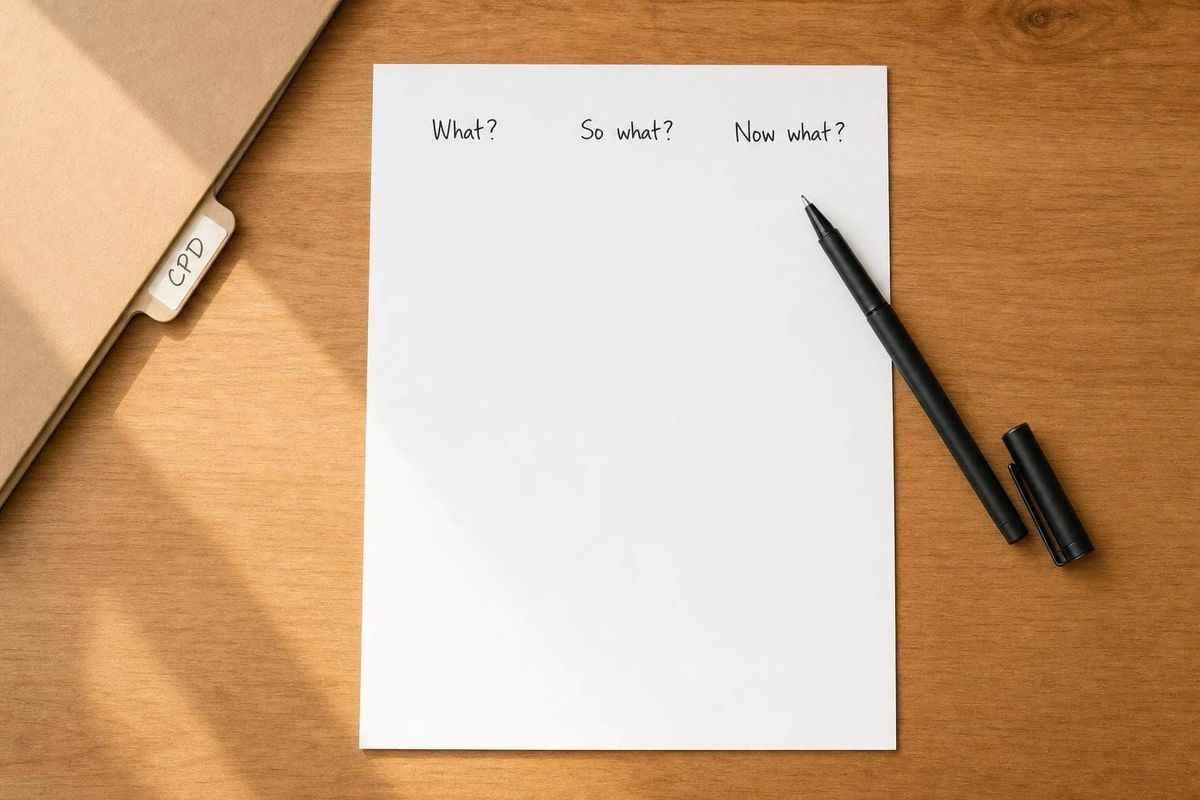
Here’s the short version: I can start a usable reflective account in 10 to 15 minutes by keeping it anonymous, choosing one recent event, and answering:
- What happened?
- So what?
- Now what?
That’s enough to turn an experience into a CPD entry for NMC, HCPC, or GMC records.
What matters most is not the story itself. It’s the learning. A good reflection shows:
- what happened
- what I learned
- what I will do next
- how it links to my professional standards
I also need to keep it safe to file:
- use Patient A or service user
- remove names and identifying details
- write dates as DD/MM/YYYY
- keep the tone neutral and factual
One useful point stands out: for NMC revalidation, I need 5 written reflective accounts every 3 years. So the goal is not to produce a long piece of writing. The goal is to make reflection a repeatable habit.
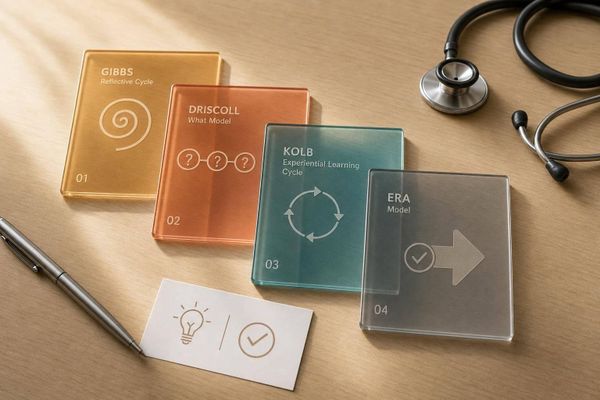
If I want a simple way to shape the draft after writing it, I can use a model:
| Model | Best use | Time |
|---|---|---|
| Driscoll | Short CPD notes | About 10 minutes |
| ERA | Brief professional records | About 10 minutes |
| Kolb | Learning linked to study or training | About 15 to 20 minutes |
| Gibbs | More involved events | 30 minutes or more |
My takeaway: start small, write plainly, focus on change in practice, and file it once the learning point and next step are clear.
Reflective Practice Models Compared: Gibbs, Driscoll, Kolb & ERA
Reflective writing assignment – EXACTLY what to write, with examples!
Start Your Guided Reflection Today
Create structured, CPD-ready reflections using recognized models like Gibbs, Driscoll, Kolb, and ERA. Perfect for NMC revalidation, HCPC CPD, and GMC appraisal.
Start Reflecting Now1. Know what reflective practice is before you start writing
Reflective practice turns a real event at work into learning you can use later. The Royal College of Nursing says it well:
"Reflection is a conscious effort to think about an activity or incident that allows us to consider what was positive or challenging and if appropriate plan how it might be enhanced, improved or done differently in the future." [1]
That’s the heart of it. Simply describing what happened isn’t enough. Reflection starts with the event, but it has to lead somewhere. The main test is whether anything changed. A useful reflection moves from what happened to what I learned to what I’ll do next. You don’t need a perfect case either. One real incident and one clear lesson is enough.
Why reflection matters for NMC, HCPC and GMC records
For NMC revalidation, nurses and midwives need to complete five written reflective accounts every three years, link each one to the Code, and talk through reflection with another NMC registrant [2][1]. These accounts do not need to be long or academic. Keep them plain and direct: say what you learned, how it changed your practice, and how it links to the Code [2].
What makes a reflection usable and safe
Whatever format you use, start with confidentiality. Pick one specific situation. Then explain what you learned, how it will shape your future practice, and how it links to your professional code. Leave out any detail that could identify patients, colleagues, or anyone else. Keep the tone objective and avoid loaded wording. For example, instead of writing "the patient was unhappy", write "the patient reported feeling unhappy" or "the patient appeared visibly distressed" [3].
If your reflection shows a clear change in practice, it does the job.
Once you know what counts as reflection, choose one real incident and keep the scope small so it’s easy to write about.
2. Pick one real event that is good enough to reflect on
Pick one real event that changed how you think, even if it felt ordinary at the time. It doesn't have to be dramatic. A success can work just as well as a problem. What matters is that the event gives you something to unpack: a decision, an outcome, or a moment of tension.
The easiest reflections usually come from a recent event. If it happened not long ago, the facts are still clear in your mind. So are your feelings, your decisions, and the small details that often matter most.
Examples of suitable reflection topics in healthcare
| Topic Category | Example |
|---|---|
| Clinical encounter or communication challenge | A patient or family interaction, handover, or conversation where information was unclear, misunderstood, or where patient safety or clinical knowledge was tested |
| Near miss or incident | A prescribing check or other incident that helped you think about error and risk |
| Team interaction | An MDT discussion, disagreement or hierarchy issue that affected teamwork |
| Training or update | A module, update or training session that changed how you approach a task |
| Something that went well | A procedure or conversation that went better than expected, and you want to repeat it |
These kinds of events can connect well to standards around safety, communication, teamwork, and trust.
A quick checklist to decide if an event is worth writing up
Use these four questions to decide whether the event is worth writing up [3]:
- Why did I respond this way?
- What was I thinking and feeling?
- What else could I have done?
- What would I do in a similar situation?
One more thing: make sure you can explain your own role clearly, not just what everyone else did. You should also be able to link the event to your professional standards, evidence-based practice, or organisational policy. If you can do both, you're in a good place to start drafting.
Reflection works best when you connect experience directly to learning.
If the event gives you clear answers to these questions, move straight to your first draft.
3. Write your first draft using three simple questions
Start with the event you picked and write from there. Use three prompts: What happened? So what? Now what? It’s a fast, simple way to begin a reflection . Get the first draft down now. You can shape it later.
What happened?
Write two or three factual sentences covering the setting, your role, and what took place [4]. Use roles instead of names, and leave out details that could identify anyone. If the account could have been written from the notes alone, it’s still description [4]. Keep this part short, then move on.
Once the facts are on the page, go straight to meaning and next steps.
So what? and Now what?
This is where the reflection starts to do some work. Explain why the event mattered to you. What shaped the outcome - communication, teamwork, the setting, or your own assumptions? What did you learn, or what did the event confirm? Link that point straight to a professional standard, evidence-based practice, or a workplace policy so the reflection can be used in formal records .
The Now what section needs to be specific. General lines like "I will improve my communication" aren’t enough. Clear actions work much better:
- "I will use the SBAR tool for all future handovers"
- "I will review the updated diabetes care guidelines"
Specific actions show what changes next.
| Section | Recommended weighting | What to include |
|---|---|---|
| What happened? | Up to one-third | Brief, anonymised facts: setting, role and event [4][3] |
| So what? | Around 30–40% | Why it mattered, what influenced it, what you learnt [4] |
| Now what? | Around 15–20% | Specific, measurable actions linked to future practice [4] |
Once the draft is written, use a formal model to structure it.
4. Use a recognised model to shape the reflection for formal records
Your three-question draft already has the raw material. The model simply gives it a clear shape for CPD or appraisal records. As Coventry University's CAW LibGuides notes:
"The big focus should be on the analysis and planning than on simply describing past events." [5]
That point matters. The aim isn't to write a long account of what happened. It's to show what you learned, what you made of it, and what you'll do next.
Each model takes the same reflection and arranges it in a different way. The best choice depends on two things: how much time you have and how involved the event was.
When to use Gibbs, Driscoll, Kolb or ERA

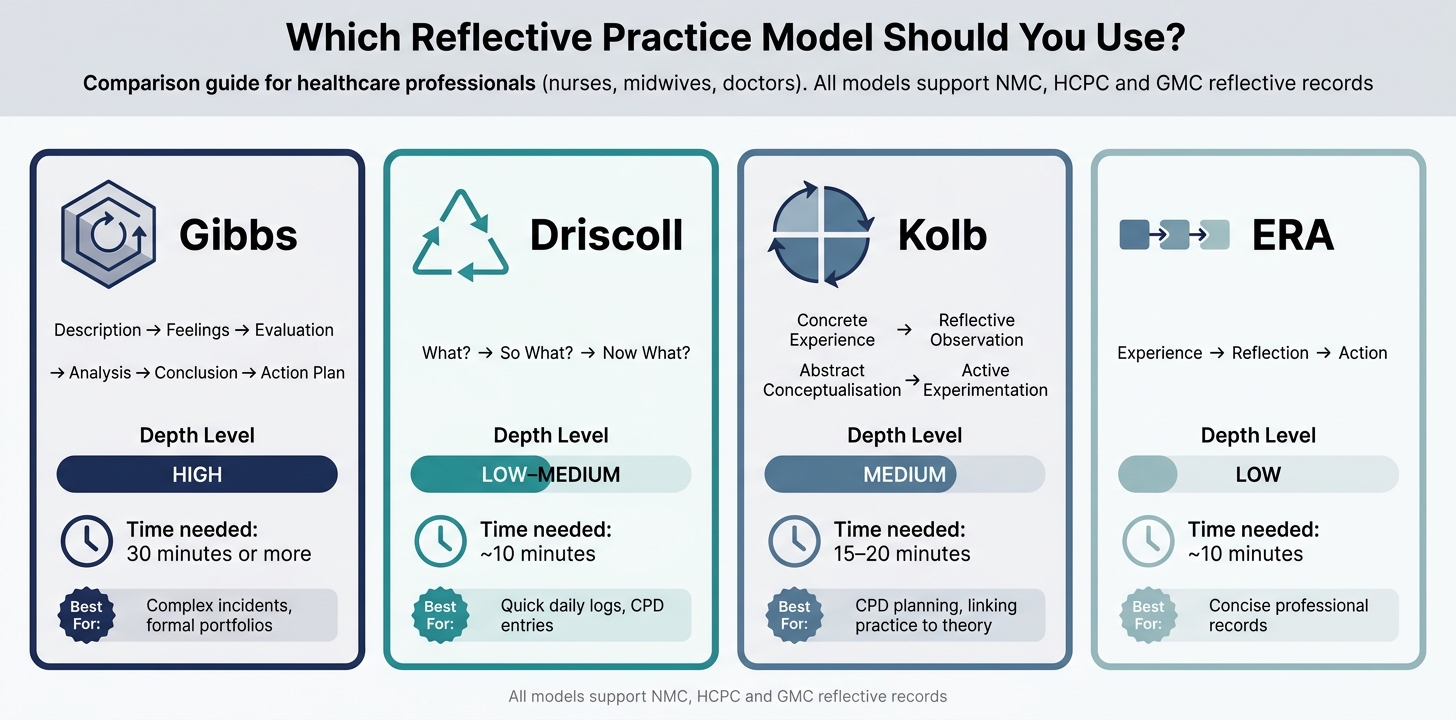
Driscoll is the fastest option. Its three questions line up neatly with the prompts you've already answered, so if you've only got ten minutes to record a learning point, it's a solid fit [6].
ERA is also short. It stands for Experience, Reflection, Action, and it works well for brief CPD entries where you want to keep the focus on what changed rather than spending too long on the background [5].
Gibbs is better when the event was more involved or had more emotional weight, and you have around 30 minutes or more to work through it properly. Its six stages - Description, Feelings, Evaluation, Analysis, Conclusion and Action Plan - move you past simple description and into closer thinking about feelings, causes and next steps. That makes it useful for involved situations and formal portfolios [5].
Kolb does a slightly different job. Use it when an experience has exposed a gap in your knowledge and you want to plan specific training or reading to deal with it .
Model comparison for busy clinicians
| Model | Stages | Depth | Best for |
|---|---|---|---|
| Gibbs | 6 | High | Complex incidents, formal portfolios |
| Driscoll | 3 | Low–Medium | Quick daily logs, CPD entries |
| Kolb | 4 | Medium | CPD planning, linking practice to theory |
| ERA | 3 | Low | Concise professional records |
Once you've picked a model, use it to shape the draft from the previous step.
How Reflection Guide can make this step easier
This is the point where many clinicians get stuck. They choose a model, then hit a blank page and try to remember each stage from memory. Reflection Guide helps cut that friction by guiding the structure and privacy checks. It is designed to support NMC revalidation, HCPC CPD and GMC appraisal records . Once the draft is structured, the next step is to check it and file it.
5. Check, file and repeat: make your reflection ready to use
Once your draft is in shape, give it one last pass so it's ready to file.
Final checks before you save or submit
This final review helps you catch anything that might weaken the reflection later.
Check these four points before saving:
- Anonymise the account. Remove names, places, and any other identifying details. Keep the wording objective. For example, "the patient reported feeling unheard" rather than "the patient was difficult" [3].
- Make the learning point explicit. Put the learning point at the centre: what you learned, how it changed your practice, and what you would do differently.
- State one clear action. Add one specific action for next time, such as using SBAR during handovers or revisiting the updated diabetes care guideline [3].
- Link to a professional area. Connect the reflection to one relevant standard, such as safety, communication, teamwork, or clinical knowledge [4].
Save the reflection in your CPD log or portfolio.
FAQs
How long should a reflection be?
There’s no fixed word count for a reflection. What matters is that it stays focused, feels manageable, and is built on careful analysis of a professional experience.
The goal is to turn that experience into a clear, honest reflection that supports your professional development.
What if I can’t think of a suitable event?
Start with smaller or routine practice activities, or with day-to-day experiences that link to your professional standards or development goals. You don’t need a dramatic event to reflect well. A recent situation, an ongoing issue, or even a simple interaction with a colleague or patient can give you plenty to think about.
Reflective models such as Gibbs’ or Driscoll’s can help you look at everyday work in a more structured way and turn it into a useful reflection. It can also help to jot down a few notes or brainstorm ideas first. That often makes it easier to spot an experience that fits.
Which reflection model should I choose?
Choose the model that best fits your situation and what feels natural to you. Gibbs’ Reflective Cycle works well when you want a more detailed reflection, while Driscoll’s “What? So what? Now what?” is simpler and faster for day-to-day use.
Schön’s model is useful if you want to reflect both during practice and after it. Overall, Gibbs and Driscoll are the models most often recommended when you want reflection to be structured and practical.